Fermat's Last Theorem
Fermat's Last Theorem is a theorem in number theory that there are no nontrivial integer solutions of xⁿ+yⁿ=zⁿ for integer n>2. It came out in 1637.
- Came out
- 1637
All 3 facts, and where they come from
Facts
3 facts · 0 confirmed by two sources · 0 cited · 3 from one source
Where this comes from
Papalocal keeps its own record. It started from these sources; what each one said is kept here as it was copied, so a change on their side never changes this page by itself. Tap one to read its version.
What Wikidata says · copied November 17, 2026 · revision 2559102315
- Described as
- theorem in number theory that there are no nontrivial integer solutions of xⁿ+yⁿ=zⁿ for integer n>2
- Other names
- La conjetura de Fermat, teorema de wiles, La última conjetura de Fermat
- What it is
- theorem
- Came out
- 1637
- Named after
- Pierre de Fermat
- Wikipedias with a page
- 84
Wikidata item Q132469 (wikidata.org/wiki/Q132469), public domain (CC0). Copied 2026-11-17.
What Wikipedia says · copied November 17, 2026 · revision 1382142422
In number theory, Fermat's Last Theorem (sometimes called Fermat's conjecture, especially in older texts) states that there are no positive integers a,b,c,n with n>2 such that an+bn=cn. The cases n=1 and n=2 have been known since antiquity to have infinitely many solutions.
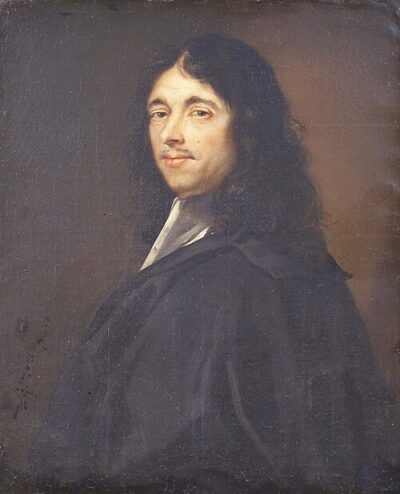
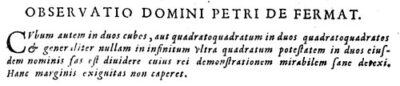
The proposition was first stated as a theorem by Pierre de Fermat around 1637 in the margin of a copy of Arithmetica. Fermat wrote that "I have discovered a truly marvelous proof of this, which this margin is too narrow to contain." Although other statements claimed by Fermat without proof were subsequently proven by others and credited as theorems of Fermat (for example, Fermat's theorem on sums of two squares), Fermat's Last Theorem resisted proof, leading to doubt that Fermat ever had a correct proof. Consequently, the proposition became known as a conjecture rather than a theorem. After 358 years of effort by mathematicians, the first successful proof was released in 1994 by Andrew Wiles and formally published in 1995. It was described as a "stunning advance" in the citation for Wiles's Abel Prize award in 2016. It also proved much of the Taniyama–Shimura conjecture, subsequently known as the modularity theorem, and opened up entire new approaches to numerous other problems and mathematically powerful modularity lifting techniques.
The unsolved problem stimulated the development of algebraic number theory in the 19th and 20th centuries. For its influence within mathematics and in culture more broadly, it is among the most notable theorems in the history of mathematics.
From the Wikipedia article “Fermat's Last Theorem” (en.wikipedia.org/wiki/Fermat's_Last_Theorem), by its contributors, under CC BY-SA 4.0 (creativecommons.org/licenses/by-sa/4.0/). Copied 2026-11-17; not changed.
Confirmed Two sources agree. Cited One source, and it names where it got it. One source One source, without a reference of its own. Sources disagree The sources disagree. We show the best-supported value and keep theirs below.
Picture: Wikimedia Commons · Public domain