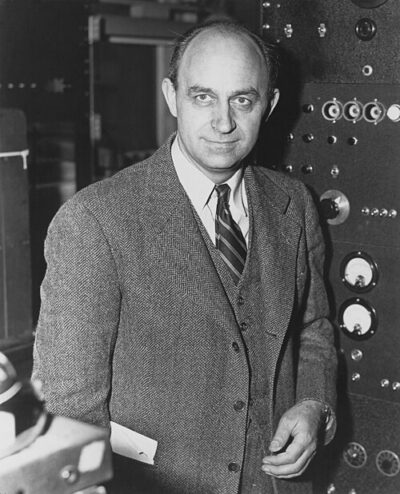
Fermi contact interaction
Fermi contact interaction is a magnetic interaction between an electron and a nucleus.
All 1 facts, and where they come from
Facts
1 facts · 0 confirmed by two sources · 0 cited · 1 from one source
Where this comes from
Papalocal keeps its own record. It started from these sources; what each one said is kept here as it was copied, so a change on their side never changes this page by itself. Tap one to read its version.
What Wikidata says · copied November 16, 2026 · revision 2551641649
- Described as
- magnetic interaction between an electron and a nucleus
- What it is
- scientific theory
- Wikipedias with a page
- 5
Wikidata item Q5444399 (wikidata.org/wiki/Q5444399), public domain (CC0). Copied 2026-11-16.
What Wikipedia says · copied November 16, 2026 · revision 1383756123
The Fermi contact interaction is the magnetic interaction between an electron and an atomic nucleus. Its major manifestation is in electron paramagnetic resonance and nuclear magnetic resonance spectroscopies, where it is responsible for the appearance of isotropic hyperfine coupling.
This requires that the electron occupies an s-orbital. The interaction is described with the parameter A, which takes the units megahertz. The magnitude of A is given by this relationshipsA=−83π⟨𝝁n⋅𝝁e⟩|Ψ(0)|2(cgs)
andA=−23μ0⟨𝝁n⋅𝝁e⟩|Ψ(0)|2,(SI)
where A is the energy of the interaction, μn is the nuclear magnetic moment, μe is the electron magnetic dipole moment, Ψ(0) is the value of the electron wavefunction at the nucleus, and ⟨⋯⟩ denotes the quantum mechanical spin coupling.
It has been pointed out that it is an ill-defined problem because the standard formulation assumes that the nucleus has a magnetic dipolar moment, which is not always the case.
From the Wikipedia article “Fermi contact interaction” (en.wikipedia.org/wiki/Fermi_contact_interaction), by its contributors, under CC BY-SA 4.0 (creativecommons.org/licenses/by-sa/4.0/). Copied 2026-11-16; not changed.
Confirmed Two sources agree. Cited One source, and it names where it got it. One source One source, without a reference of its own. Sources disagree The sources disagree. We show the best-supported value and keep theirs below.