
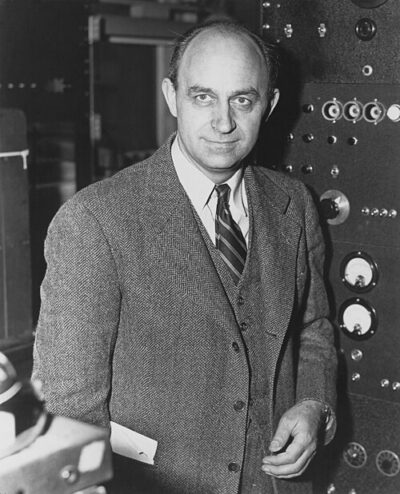
Enrico Fermi
Enrico Fermi was an Italian-American physicist. Born September 29, 1901, in Rome. Died November 28, 1954, in Chicago. Known for Fermi–Dirac statistics, Fermi's golden rule and Fermi paradox. Educated at University of Pisa and Scuola Normale Superiore. Classe di Scienze. Awards include Nobel Prize in Physics, Max Planck Medal and Rumford Prize.
Facts
67 facts · 2 confirmed by two sources · 44 cited · 21 from one source
Where this comes from
Papalocal keeps its own record. It started from these sources; what each one said is kept here as it was copied, so a change on their side never changes this page by itself. Tap one to read its version.
What Wikidata says · copied November 13, 2026 · revision 2568291020
- Described as
- Italian-American physicist (1901–1954)
- Other names
- Fermi
- Born
- September 29, 1901 · 12 references
- Died
- November 28, 1954 · 11 references
- Born in
- Rome · 6 references
- Died in
- Chicago · 9 references
- Buried in
- Oak Woods Cemetery · 2 references
- Cause of death
- stomach cancer · 1 reference
- Citizen of
- Kingdom of Italy (–1946); Italy (1946–) · 4 references; United States · 3 references
- Occupation
- physicist · 4 references; theoretical physicist · 1 reference; nuclear physicist · 1 reference; university teacher · 1 reference; inventor · 1 reference
- Worked for
- University of Florence (1924–1926) · 2 references; Sapienza University of Rome (1926–1938) · 2 references; Columbia University (1939–1942) · 2 references; University of Chicago (1942–1954) · 2 references; University of Göttingen · 1 reference; Leiden University · 1 reference; Enrico Fermi Institute · 1 reference
- Education
- University of Pisa · 1 reference; Scuola Normale Superiore. Classe di Scienze (1918–1922) · 1 reference; Leiden University (1923–1924) · 1 reference; University of Göttingen (1923) · 1 reference
- Member of
- Royal Society of London (1950–) · 3 references; German Academy of Sciences Leopoldina (1935–) · 1 reference; Academy of Sciences of the USSR (1929–) · 1 reference; American Philosophical Society (1939–) · 2 references; Accademia Nazionale delle Scienze detta dei XL (1933–) · 2 references; National Academy of Sciences (1945–) · 1 reference; Academy of Sciences of Turin (1928–) · 1 reference; Accademia Tiberina (1928–) · 1 reference; Romanian Academy (1938–) · 1 reference; Accademia Nazionale dei Lincei (1932–) · 1 reference
- Known for
- Fermi–Dirac statistics; Fermi's golden rule; Fermi paradox; Thomas–Fermi model; Fermi problem; Fermi's interaction; Fermi contact interaction; Fermi–Pasta–Ulam–Tsingou problem
- Awards
- Nobel Prize in Physics (1938) · 3 references; Max Planck Medal (1954) · 1 reference; Rumford Prize (1953) · 1 reference; Matteucci Medal (1926) · 2 references; Franklin Medal (1947) · 2 references; Hughes Medal (1942) · 2 references; Henry Norris Russell Lectureship (1953) · 1 reference; National Inventors Hall of Fame (1976) · 1 reference; Silliman Memorial Lectures (1949) · 1 reference; Barnard Medal for Meritorious Service to Science (1950) · 1 reference; Richtmyer Memorial Lecture Award (1952) · 1 reference; Fellow of the American Physical Society (1939) · 1 reference; Foreign Member of the Royal Society (1950) · 1 reference
- Field
- nuclear physics; quantum mechanics; statistical mechanics; physics · 1 reference; nuclear reaction · 1 reference; quantum theory · 1 reference
- Spouse
- Laura Fermi (1928–1954) · 1 reference
- Religion
- agnosticism
- Lived in
- United States (1939–1954); Rome; Italy
- Wikipedias with a page
- 173
Wikidata item Q8753 (wikidata.org/wiki/Q8753), public domain (CC0). Copied November 13, 2026.
What Wikipedia says · copied November 13, 2026 · revision 1385344374
Enrico Fermi (Italian: [enˈriːko ˈfermi]; 29 September 1901 – 28 November 1954) was an Italian and naturalized-American physicist, renowned for being the creator of the world's first artificial nuclear reactor, Chicago Pile-1, and a member of the Manhattan Project. He won the 1938 Nobel Prize in Physics "for his demonstrations of the existence of new radioactive elements produced by neutron irradiation, and for his related discovery of nuclear reactions brought about by slow neutrons". He has been called the "architect of the nuclear age" and the "architect of the atomic bomb". He was one of very few physicists to excel in both theoretical and experimental physics. With his colleagues, Fermi filed several patents related to the use of nuclear power, all of which were taken over by the US government. He made significant contributions to the development of statistical mechanics, quantum theory, and nuclear and particle physics.
Fermi's first major contribution involved the field of statistical mechanics. After Wolfgang Pauli formulated his exclusion principle in 1925, Fermi followed with a paper in which he applied the principle to an ideal gas, employing a statistical formulation now known as Fermi–Dirac statistics. Today, particles that obey the exclusion principle are called "fermions". Pauli later postulated the existence of an uncharged invisible particle emitted along with an electron during beta decay, to satisfy the law of conservation of energy. Fermi took up this idea, developing a model that incorporated the postulated particle, which he named the "neutrino". His theory, later referred to as Fermi's interaction and now called weak interaction, described one of the four fundamental interactions in nature. Through experiments inducing radioactivity with the recently discovered neutron, Fermi discovered that slow neutrons were more easily captured by atomic nuclei than fast ones, and he developed the Fermi age equation to describe this. After bombarding thorium and uranium with slow neutrons, he concluded that he had created new elements. Although he was awarded the Nobel Prize for this discovery, the new elements were later revealed to be nuclear fission products.
Fermi left Italy in 1938 to escape new Italian racial laws that affected his Jewish wife, Laura Capon. He immigrated to the United States, where he worked on the Manhattan Project during World War II. Fermi led the team at the University of Chicago that designed and built Chicago Pile-1, which went critical on 2 December 1942, demonstrating the first human-created, self-sustaining nuclear chain reaction. He was on hand when the X-10 Graphite Reactor at Oak Ridge, Tennessee, went critical in 1943, and when the B Reactor at the Hanford Site did so the next year. At Los Alamos, he headed F Division, part of which worked on Edward Teller's thermonuclear "Super" bomb. He was present at the Trinity test on 16 July 1945, the first test of a full nuclear bomb explosion, where he used his Fermi method to estimate the bomb's yield.
After the war, he helped establish the Institute for Nuclear Studies in Chicago, and served on the General Advisory Committee, chaired by J. Robert Oppenheimer, which advised the Atomic Energy Commission on nuclear matters. After the detonation of the first Soviet fission bomb in August 1949, he strongly opposed the development of a hydrogen bomb on both moral and technical grounds. He was among the scientists who testified on Oppenheimer's behalf at the 1954 hearing that resulted in the denial of Oppenheimer's security clearance.
Fermi did important work in particle physics, especially related to pions and muons, and he speculated that cosmic rays arose when the material was accelerated by magnetic fields in interstellar space. Many awards, concepts, and institutions are named after Fermi, including the Fermi 1 (breeder reactor), the Fermi Explorer mission, the Enrico Fermi Nuclear Generating Station, the Enrico Fermi Award, the Enrico Fermi Institute, the Fermi National Accelerator Laboratory (Fermilab), the Fermi Gamma-ray Space Telescope, the Fermi paradox, and the synthetic element fermium, making him one of 16 scientists who have elements named after them.
- Born, in its opening lines
- September 29, 1901
- Died, in its opening lines
- November 28, 1954
From the Wikipedia article “Enrico Fermi” (en.wikipedia.org/wiki/Enrico_Fermi), by its contributors, under CC BY-SA 4.0 (creativecommons.org/licenses/by-sa/4.0/). Copied November 13, 2026; not changed.
Confirmed Two sources agree. Cited One source, and it names where it got it. One source One source, without a reference of its own. Sources disagree The sources disagree. We show the best-supported value and keep theirs below.
