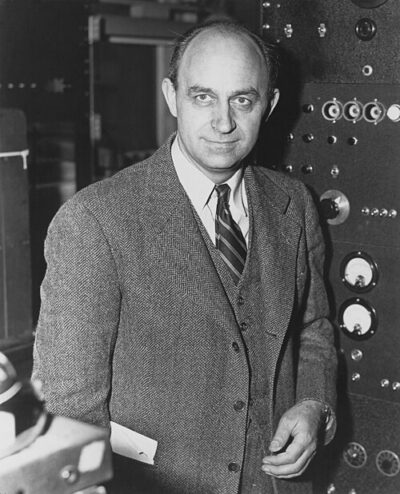
Fermi–Pasta–Ulam–Tsingou problem
Fermi–Pasta–Ulam–Tsingou problem is an apparent paradox in chaos theory that many complicated enough physical systems exhibited almost exactly periodic behavior instead of ergodic behavior.
All 5 facts, and where they come from
Facts
5 facts · 0 confirmed by two sources · 0 cited · 5 from one source
Where this comes from
Papalocal keeps its own record. It started from these sources; what each one said is kept here as it was copied, so a change on their side never changes this page by itself. Tap one to read its version.
What Wikidata says · copied November 16, 2026 · revision 2538494407
- Described as
- apparent paradox in chaos theory that many complicated enough physical systems exhibited almost exactly periodic behavior instead of ergodic behavior
- Other names
- Fermi–Pasta–Ulam problem
- What it is
- physical phenomenon; physical paradox; computer simulation
- Named after
- Enrico Fermi; John Pasta
- Wikipedias with a page
- 8
Wikidata item Q462254 (wikidata.org/wiki/Q462254), public domain (CC0). Copied 2026-11-16.
What Wikipedia says · copied November 16, 2026 · revision 1369282089
In physics, the Fermi–Pasta–Ulam–Tsingou (FPUT) problem or formerly the Fermi–Pasta–Ulam problem was the apparent paradox in chaos theory that many complicated enough physical systems exhibited almost exactly periodic behavior – called Fermi–Pasta–Ulam–Tsingou recurrence (or Fermi–Pasta–Ulam recurrence) – instead of the expected ergodic behavior. This came as a surprise, as Enrico Fermi, certainly, expected the system to thermalize in a fairly short time. That is, it was expected for all vibrational modes to eventually appear with equal strength, as per the equipartition theorem, or, more generally, the ergodic hypothesis. Yet here was a system that appeared to evade the ergodic hypothesis. Although the recurrence is easily observed, it eventually became apparent that over much, much longer time periods, the system does eventually thermalize. Multiple competing theories have been proposed to explain the behavior of the system, and it remains a topic of active research.
The original intent was to find a physics problem worthy of numerical simulation on the then-new MANIAC computer. Fermi felt that thermalization would pose such a challenge. As such, it represents one of the earliest uses of digital computers in mathematical research; simultaneously, the unexpected results launched the study of nonlinear systems.
From the Wikipedia article “Fermi–Pasta–Ulam–Tsingou problem” (en.wikipedia.org/wiki/Fermi–Pasta–Ulam–Tsingou_problem), by its contributors, under CC BY-SA 4.0 (creativecommons.org/licenses/by-sa/4.0/). Copied 2026-11-16; not changed.
Confirmed Two sources agree. Cited One source, and it names where it got it. One source One source, without a reference of its own. Sources disagree The sources disagree. We show the best-supported value and keep theirs below.