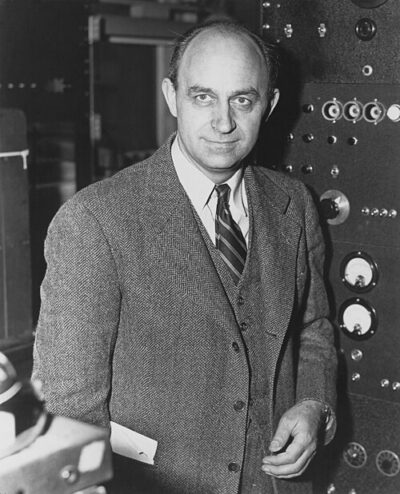
Fermi's interaction
Fermi's interaction is a mechanism of beta decay proposed in 1933 involving a non-renormalizable four-fermion term in the action.
All 2 facts, and where they come from
Facts
2 facts · 0 confirmed by two sources · 0 cited · 2 from one source
Where this comes from
Papalocal keeps its own record. It started from these sources; what each one said is kept here as it was copied, so a change on their side never changes this page by itself. Tap one to read its version.
What Wikidata says · copied November 16, 2026 · revision 2550360480
- Described as
- mechanism of beta decay proposed in 1933 involving a non-renormalizable four-fermion term in the action
- Other names
- Fermi interaction
- What it is
- scientific theory
- Named after
- Enrico Fermi
- Wikipedias with a page
- 15
Wikidata item Q1406423 (wikidata.org/wiki/Q1406423), public domain (CC0). Copied 2026-11-16.
What Wikipedia says · copied November 16, 2026 · revision 1374256933
In particle physics, Fermi's interaction (also the Fermi theory of beta decay or the Fermi four-fermion interaction) is an explanation of the beta decay, proposed by Enrico Fermi in 1933. The theory posits four fermions directly interacting with one another (at one vertex of the associated Feynman diagram). This interaction explains beta decay of a neutron by direct coupling of a neutron with an electron, a neutrino (later determined to be an antineutrino) and a proton.
Fermi first introduced this coupling in his description of beta decay in 1933. The Fermi interaction was the precursor to the theory for the weak interaction where the interaction between the proton–neutron and electron–antineutrino is mediated by a virtual W− boson, of which the Fermi theory is the low-energy effective field theory.
According to Eugene Wigner, who together with Pascual Jordan introduced the Jordan–Wigner transformation, Fermi's paper on beta decay was his main contribution to the history of physics.
From the Wikipedia article “Fermi's interaction” (en.wikipedia.org/wiki/Fermi's_interaction), by its contributors, under CC BY-SA 4.0 (creativecommons.org/licenses/by-sa/4.0/). Copied 2026-11-16; not changed.
Confirmed Two sources agree. Cited One source, and it names where it got it. One source One source, without a reference of its own. Sources disagree The sources disagree. We show the best-supported value and keep theirs below.