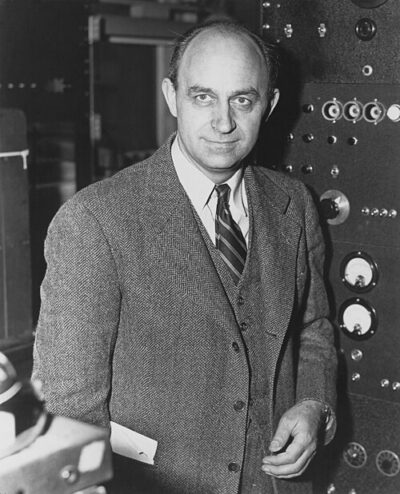
Thomas–Fermi model
Thomas–Fermi model is a primitive quantum mechanical model of electronic structure.
All 4 facts, and where they come from
Facts
4 facts · 0 confirmed by two sources · 0 cited · 4 from one source
Where this comes from
Papalocal keeps its own record. It started from these sources; what each one said is kept here as it was copied, so a change on their side never changes this page by itself. Tap one to read its version.
What Wikidata says · copied November 16, 2026 · revision 2515887453
- Described as
- primitive quantum mechanical model of electronic structure
- What it is
- atom model; scientific theory
- Named after
- Llewellyn Thomas; Enrico Fermi
- Wikipedias with a page
- 11
Wikidata item Q900431 (wikidata.org/wiki/Q900431), public domain (CC0). Copied 2026-11-16.
What Wikipedia says · copied November 16, 2026 · revision 1315172488
The Thomas–Fermi (TF) model, named after Llewellyn Thomas and Enrico Fermi, is a quantum mechanical theory for the electronic structure of many-body systems developed semiclassically shortly after the introduction of the Schrödinger equation. It stands separate from wave function theory as being formulated in terms of the electronic density alone and as such is viewed as a precursor to modern density functional theory. The Thomas–Fermi model is correct only in the limit of an infinite nuclear charge. Using the approximation for realistic systems yields poor quantitative predictions, even failing to reproduce some general features of the density such as shell structure in atoms and Friedel oscillations in solids. It has, however, found modern applications in many fields through the ability to extract qualitative trends analytically and with the ease at which the model can be solved. The kinetic energy expression of Thomas–Fermi theory is also used as a component in more sophisticated density approximation to the kinetic energy within modern orbital-free density functional theory.
Working independently, Thomas and Fermi used this model in 1927 to approximate the distribution of electrons in an atom. Although electrons are distributed nonuniformly in an atom, the approximation was made that in each small volume element ΔV (i.e. locally), the electrons are distributed uniformly. The electron density n(𝐫) can still vary from one volume element to the next.
From the Wikipedia article “Thomas–Fermi model” (en.wikipedia.org/wiki/Thomas–Fermi_model), by its contributors, under CC BY-SA 4.0 (creativecommons.org/licenses/by-sa/4.0/). Copied 2026-11-16; not changed.
Confirmed Two sources agree. Cited One source, and it names where it got it. One source One source, without a reference of its own. Sources disagree The sources disagree. We show the best-supported value and keep theirs below.