Fermi paradox
Fermi paradox is an apparent contradiction between the lack of evidence and high probability estimates for the existence of extraterrestrial civilizations. It came out in 1950.
- Came out
- 1950
All 5 facts, and where they come from
Facts
5 facts · 0 confirmed by two sources · 0 cited · 5 from one source
Where this comes from
Papalocal keeps its own record. It started from these sources; what each one said is kept here as it was copied, so a change on their side never changes this page by itself. Tap one to read its version.
What Wikidata says · copied November 16, 2026 · revision 2516861775
- Described as
- apparent contradiction between the lack of evidence and high probability estimates for the existence of extraterrestrial civilizations
- Other names
- Fermi-Hart paradox
- What it is
- paradox; scientific theory; Fermi problem
- Came out
- 1950
- Named after
- Enrico Fermi
- Wikipedias with a page
- 72
Wikidata item Q33580 (wikidata.org/wiki/Q33580), public domain (CC0). Copied 2026-11-16.
What Wikipedia says · copied November 16, 2026 · revision 1385630065
The Fermi paradox is the seeming inconsistency between the lack of evidence of extraterrestrial civilizations and the apparently high likelihood of their existence.
In simple terms, the Fermi paradox asks why, given the vast number of stars and potentially habitable planets in our observable universe, there is no clear evidence of extraterrestrial civilizations.
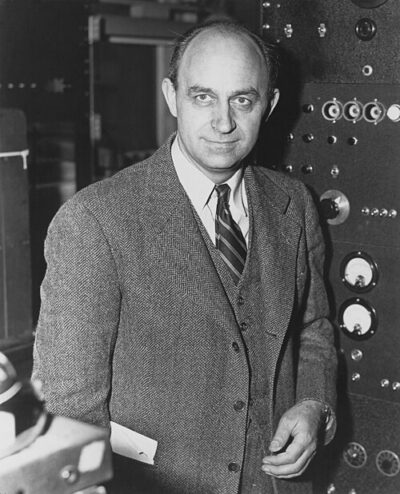
The paradox is named after physicist Enrico Fermi who blurted out the question—remembered by Emil Konopinski as "But where is everybody?"—during lunchtime after the conversation had already moved on to other topics. This happened at Los Alamos in 1950 with colleagues Konopinski, Edward Teller, and Herbert York. The paradox first appeared in print in a 1963 paper by Carl Sagan, and the paradox has since been more fully described by scientists. Early formulations of the paradox have also been identified in writings by Bernard Le Bovier de Fontenelle (1686) and Jules Verne (1865), and by Soviet rocket scientist Konstantin Tsiolkovsky (1933).
There have been many attempts to resolve the Fermi paradox, such as suggesting that intelligent extraterrestrial beings are extremely rare, that the lifetime of such civilizations is short, or that they exist but (for various reasons) humans see no evidence.
From the Wikipedia article “Fermi paradox” (en.wikipedia.org/wiki/Fermi_paradox), by its contributors, under CC BY-SA 4.0 (creativecommons.org/licenses/by-sa/4.0/). Copied 2026-11-16; not changed.
Confirmed Two sources agree. Cited One source, and it names where it got it. One source One source, without a reference of its own. Sources disagree The sources disagree. We show the best-supported value and keep theirs below.