Fortitude
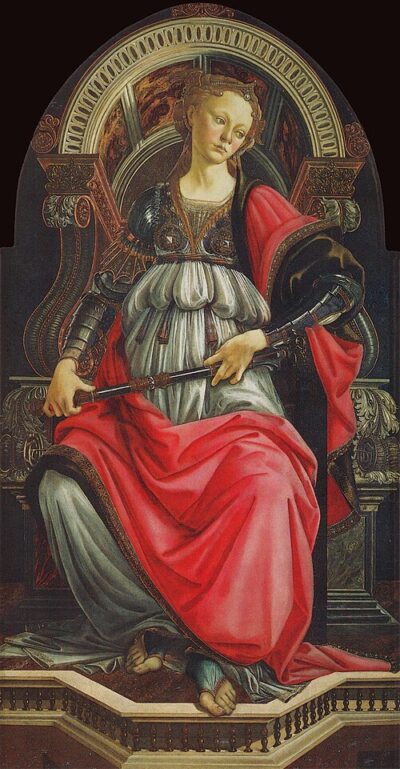
Fortitude is a painting by Sandro Botticelli, Uffizi. It came out in 1470.
- Came out
- 1470
- Created by
- Sandro Botticelli
- Genre
- allegory
All 6 facts, and where they come from
Facts
6 facts · 0 confirmed by two sources · 2 cited · 4 from one source
Where this comes from
Papalocal keeps its own record. It started from these sources; what each one said is kept here as it was copied, so a change on their side never changes this page by itself. Tap one to read its version.
What Wikidata says · copied November 17, 2026 · revision 2565801184
- Described as
- painting by Sandro Botticelli, Uffizi
- Other names
- Virtues
- What it is
- painting · 2 references
- Created by
- Sandro Botticelli · 1 reference
- Genre
- allegory
- Came out
- 1470 · 2 references
- Country
- Italy
- Official website
- https://www.uffizi.it/opere/fortezza
- Wikipedias with a page
- 10
Wikidata item Q1109340 (wikidata.org/wiki/Q1109340), public domain (CC0). Copied 2026-11-17.
What Wikipedia says · copied November 17, 2026 · revision 1376857585
Fortitude (Italian: Fortezza) is a painting by the Italian Renaissance master Sandro Botticelli, finished in 1470. Housed in the Galleria degli Uffizi, in Florence, Italy, Fortitude was the first recorded masterpiece by Botticelli.
This work originally belonged to a set of seven panels representing Virtues, intended to decorate the Tribunal Hall of Palazzo della Signoria in Florence. The other six panels are painted by Piero del Pollaiuolo's workshop. Unlike the other panels in the cycle, painted on cypress wood, the Fortitude is painted on poplar, a more commonly used wood for painting on panels in Tuscany.
The 1.67 x 0.87–meter painting was produced with tempera paint on a wood panel. Tempera paint consists in mixing the dry powdered colors with yolk of egg, slightly thinned with acetic acid or water, instead of mixing the colors with oil or varnish as in the case of oil painting. The colors thus mixed are usually laid on a priming of gesso, though other grounds may be used.
The woman represented in Fortitude could be Lucrezia Donati.
From the Wikipedia article “Fortitude (Botticelli)” (en.wikipedia.org/wiki/Fortitude_(Botticelli)), by its contributors, under CC BY-SA 4.0 (creativecommons.org/licenses/by-sa/4.0/). Copied 2026-11-17; not changed.
Confirmed Two sources agree. Cited One source, and it names where it got it. One source One source, without a reference of its own. Sources disagree The sources disagree. We show the best-supported value and keep theirs below.
Picture: Sandro Botticelli, via Wikimedia Commons · Public domain