
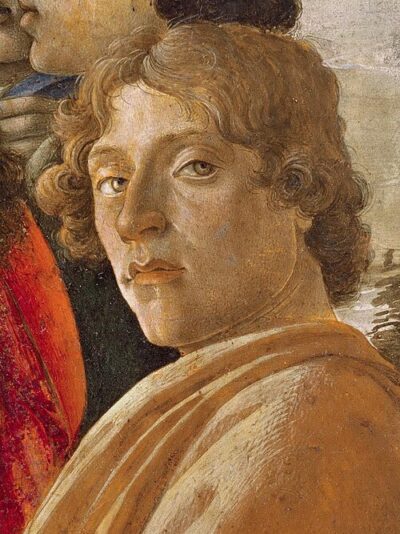
Sandro Botticelli was an Italian painter. Born 1445, in Florence. Died May 17, 1510, in Florence. Known for The Birth of Venus, Adoration of the Magi and Primavera.
Facts
30 facts · 2 confirmed by two sources · 15 cited · 13 from one source
Where this comes from
Papalocal keeps its own record. It started from these sources; what each one said is kept here as it was copied, so a change on their side never changes this page by itself. Tap one to read its version.
What Wikidata says · copied November 16, 2026 · revision 2568845315
- Described as
- Italian painter (1445–1510)
- Other names
- Alessandro Botticelli, Botticelli, s. botticelli, A. Botticelli, Alessandro di Mariano di Vanni de Filipepi, Allessandro Filipepi Botticelli, Alessandro Di Filipepi, Alessandro di Mariano Filipepi, Alessandro Di Mariano Filipepi, A. Boticello, Alexander Botticelli, boticelli
- Born
- 1445 · 3 references
- Died
- May 17, 1510 · 5 references
- Born in
- Florence · 3 references
- Died in
- Florence · 4 references
- Buried in
- Ognissanti Church
- Name at birth
- Alessandro di Mariano di Vanni Filipepi · 1 reference
- Citizen of
- Italy · 1 reference
- Occupation
- painter · 3 references; draftsperson · 1 reference; architectural drafter · 1 reference; fresco painter · 2 references
- Worked for
- Andrea del Verrocchio · 1 reference
- Genre
- portrait · 2 references; history painting · 2 references; religious painting · 1 reference; allegory · 1 reference; mythological painting · 1 reference; religious art · 1 reference
- Known for
- The Birth of Venus; Adoration of the Magi; Primavera; Fortitude; Venus and the Three Graces Presenting Gifts to Giovanna degli Albizzi · 1 reference; Annunciation · 1 reference; Birth of Christ · 1 reference; Madonna and Child · 1 reference; Madonna and Child with St. John the Baptist · 1 reference; Madonna and Child with Angels Carrying Candlesticks · 1 reference
- Siblings
- Simone Filipepi
- Religion
- Catholic Church
- Wikipedias with a page
- 115
Wikidata item Q5669 (wikidata.org/wiki/Q5669), public domain (CC0). Copied November 16, 2026.
What Wikipedia says · copied November 16, 2026 · revision 1373618718
Alessandro di Mariano di Vanni Filipepi (c. 1445 – May 17, 1510), better known as Sandro Botticelli ( BOT-ih-CHEL-ee; Italian: [ˈsandro bottiˈtʃɛlli]) or simply Botticelli, was an Italian painter of the Early Renaissance. Botticelli's posthumous reputation suffered until the late 19th century, when he was rediscovered by the Pre-Raphaelites who stimulated a reappraisal of his work. Since then, his paintings have been seen to represent the linear grace of late Italian Gothic and some Early Renaissance painting, even though they date from the latter half of the Italian Renaissance period.
In addition to the mythological subjects for which he is best known today, Botticelli painted a wide range of religious subjects (including dozens of renditions of the Madonna and Child, many in the round tondo shape) and also some portraits. His best-known works are The Birth of Venus and Primavera, both in the Uffizi in Florence, which holds many of Botticelli's works. Botticelli lived all his life in the same neighbourhood of Florence; his only significant times elsewhere were the months he spent painting in Pisa in 1474 and the Sistine Chapel in Rome in 1481–82. Botticelli received patronage from members of the Medici family, including Lorenzo de' Medici and his circle.
Only one of Botticelli's paintings, the Mystic Nativity (National Gallery, London) is inscribed with a date (1501), but others can be dated with varying degrees of certainty on the basis of archival records, so the development of his style can be traced with some confidence. He was an independent master for all the 1470s, which saw his reputation soar. The 1480s were his most successful decade, the one in which his large mythological paintings were completed along with many of his most famous Madonnas. By the 1490s, his style became more personal and to some extent mannered. His last works show him moving in a direction opposite to that of Leonardo da Vinci (seven years his junior) and the new generation of painters creating the High Renaissance style, and instead returning to a style that many have described as more Gothic or "archaic".
- Born, in its opening lines
- c. 1445
- Died, in its opening lines
- May 17, 1510
From the Wikipedia article “Sandro Botticelli” (en.wikipedia.org/wiki/Sandro_Botticelli), by its contributors, under CC BY-SA 4.0 (creativecommons.org/licenses/by-sa/4.0/). Copied November 16, 2026; not changed.
Confirmed Two sources agree. Cited One source, and it names where it got it. One source One source, without a reference of its own. Sources disagree The sources disagree. We show the best-supported value and keep theirs below.
