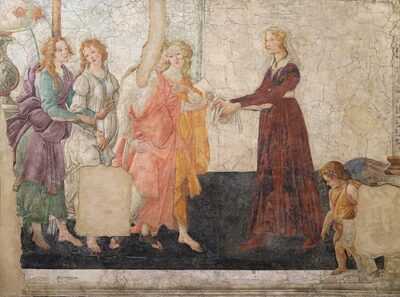
Venus and the Three Graces Presenting Gifts to Giovanna degli Albizzi
Venus and the Three Graces Presenting Gifts to Giovanna degli Albizzi is a fresco painting by Sandro Botticelli. It is part of cycle of frescoes by Sandro Botticelli at Villa Lemmi.
- Came out
- 1480s
- Created by
- Sandro Botticelli
- Genre
- mythological painting
All 10 facts, and where they come from
Facts
10 facts · 0 confirmed by two sources · 3 cited · 7 from one source
Where this comes from
Papalocal keeps its own record. It started from these sources; what each one said is kept here as it was copied, so a change on their side never changes this page by itself. Tap one to read its version.
What Wikidata says · copied November 17, 2026 · revision 2465633901
- Described as
- fresco painting by Sandro Botticelli
- Other names
- Liberal Arts, Woman Confronts Liberal Arts, Venus and the Three Graces Presenting Gifts to a Young Woman
- What it is
- wall painting; mural; fresco
- Created by
- Sandro Botticelli · 2 references
- Genre
- mythological painting · 1 reference
- Part of the series
- cycle of frescoes by Sandro Botticelli at Villa Lemmi
- Came out
- 1480s · 1 reference
- Country
- France (1881–); Italy (–1881)
- Owned by
- French State · 1 reference
- Wikipedias with a page
- 6
Wikidata item Q1114881 (wikidata.org/wiki/Q1114881), public domain (CC0). Copied 2026-11-17.
What Wikipedia says · copied November 17, 2026 · revision 1376021458
Venus and the Three Graces Presenting Gifts to a Young Woman, also known as Gioo degli Albizzi Receiving a Gift of Flowers from Venus (Italian: Venere e le tre Grazie offrono doni a una giovane), is a fresco painting by the Italian Renaissance painter Sandro Botticelli of circa 1483–1486. The painting and its companion piece, A Young Man Being Introduced to the Seven Liberal Arts, originally decorated the walls of Villa Lemmi, a country villa near Florence owned by Giovanni Tornabuoni, uncle of Lorenzo de' Medici and head of the Roman branch of the Medici Bank. They were probably commissioned for the wedding in 1486 of Giovanni's son Lorenzo to Giovanna of the Albizzi family, and are therefore thought to depict the two.
Venus and the Three Graces Presenting Gifts to a Young Woman shows a young woman, probably Giovanna Tornabuoni, being received by Venus and the three Graces. Giovanna holds open a white cloth, into which Venus is laying roses symbolizing beauty and love.
Both paintings were discovered at Villa Lemmi in 1873 under a coat of whitewash and removed from the wall and transferred to a canvas support. They are now in the Musée du Louvre, Paris.
From the Wikipedia article “Venus and the Three Graces Presenting Gifts to a Young Woman” (en.wikipedia.org/wiki/Venus_and_the_Three_Graces_Presenting_Gifts_to_a_Young_Woman), by its contributors, under CC BY-SA 4.0 (creativecommons.org/licenses/by-sa/4.0/). Copied 2026-11-17; not changed.
Confirmed Two sources agree. Cited One source, and it names where it got it. One source One source, without a reference of its own. Sources disagree The sources disagree. We show the best-supported value and keep theirs below.
Picture: Sandro Botticelli, via Wikimedia Commons · Public domain