Primavera
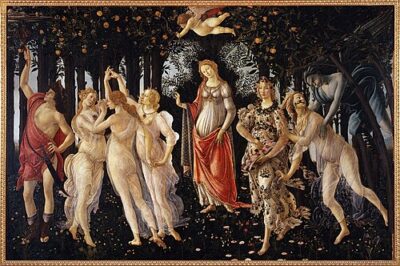
Primavera is a painting by Sandro Botticelli. It is part of mythological paintings by Botticelli.
- Came out
- 1480s
- Created by
- Sandro Botticelli
- Genre
- mythological painting
All 7 facts, and where they come from
Facts
7 facts · 0 confirmed by two sources · 2 cited · 5 from one source
Where this comes from
Papalocal keeps its own record. It started from these sources; what each one said is kept here as it was copied, so a change on their side never changes this page by itself. Tap one to read its version.
What Wikidata says · copied November 17, 2026 · revision 2568661983
- Described as
- painting by Sandro Botticelli
- Other names
- La Primavera, Spring, Allegory of Spring, Primavera (Botticelli), Primavera Botticelli
- What it is
- painting · 1 reference
- Created by
- Sandro Botticelli · 1 reference
- Genre
- mythological painting; allegory
- Part of the series
- mythological paintings by Botticelli
- Came out
- 1480s · 2 references
- Country
- Italy
- Wikipedias with a page
- 42
Wikidata item Q549847 (wikidata.org/wiki/Q549847), public domain (CC0). Copied 2026-11-17.
What Wikipedia says · copied November 17, 2026 · revision 1375680048
Primavera (Italian pronunciation: [primaˈvɛːra], meaning "Spring") is a large panel painting in tempera paint by the Italian Renaissance painter Sandro Botticelli made in the late 1470s or early 1480s (datings vary). It has been described as "one of the most written about, and most controversial paintings in the world", and also "one of the most popular paintings in Western art".
The painting depicts a group of figures from classical mythology in a garden, but no story has been found that brings this particular group together. Most critics agree that the painting is an allegory based on the lush growth of Spring, but accounts of any precise meaning vary, though many involve the Renaissance Neoplatonism which then fascinated intellectual circles in Florence. The subject was first described as Primavera by the art historian Giorgio Vasari who saw it at Villa Castello, just outside Florence, by 1550.
Although the two are now known not to be a pair, the painting is inevitably discussed with Botticelli's other very large mythological painting, The Birth of Venus, also in the Uffizi. They are among the most famous paintings in the world, and icons of the Italian Renaissance; of the two, the Birth is even better known than the Primavera. As depictions of subjects from classical mythology on a very large scale, they were virtually unprecedented in Western art since classical antiquity.
The history of the painting is not certainly known; it may have been commissioned by one of the Medici family, but the certainty of its commission is unknown. It draws from a number of classical and Renaissance literary sources, including the works of the Ancient Roman poet Ovid and, less certainly, Lucretius, and may also allude to a poem by Poliziano, the Medici house poet who may have helped Botticelli devise the composition. Since 1919, the painting has been part of the collection of the Uffizi Gallery in Florence, Italy.
From the Wikipedia article “Primavera (Botticelli)” (en.wikipedia.org/wiki/Primavera_(Botticelli)), by its contributors, under CC BY-SA 4.0 (creativecommons.org/licenses/by-sa/4.0/). Copied 2026-11-17; not changed.
Confirmed Two sources agree. Cited One source, and it names where it got it. One source One source, without a reference of its own. Sources disagree The sources disagree. We show the best-supported value and keep theirs below.
Picture: Sandro Botticelli, via Wikimedia Commons · Public domain