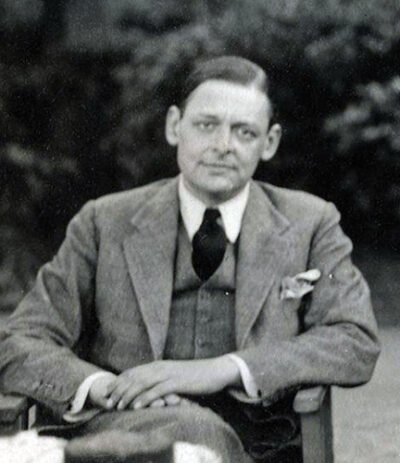
Four Quartets
Four Quartets is a 1943 cycle of poems by T.S. Eliot. It was written by T. S. Eliot.
- Published
- 1943
- Written by
- T. S. Eliot
- Genre
- poetry
- Country of origin
- United States
All 7 facts, and where they come from
Facts
7 facts · 0 confirmed by two sources · 0 cited · 7 from one source
Where this comes from
Papalocal keeps its own record. It started from these sources; what each one said is kept here as it was copied, so a change on their side never changes this page by itself. Tap one to read its version.
What Wikidata says · copied November 16, 2026 · revision 2487968266
- Described as
- 1943 cycle of poems by T.S. Eliot
- What it is
- literary work
- Written by
- T. S. Eliot
- Publisher
- Harcourt
- Genre
- poetry · 1 reference
- Published
- 1943
- Language
- English
- Country of origin
- United States
- Wikipedias with a page
- 15
Wikidata item Q2468448 (wikidata.org/wiki/Q2468448), public domain (CC0). Copied 2026-11-16.
What Wikipedia says · copied November 16, 2026 · revision 1384330357
The Four Quartets is a set of four poems written by T. S. Eliot that were published over a six-year period. The first poem, Burnt Norton, was published with a collection of his early works (1936's Collected Poems 1909–1935).
After a few years, Eliot composed the other three poems, East Coker, The Dry Salvages and Little Gidding, which were written during World War II and the air-raids on Great Britain. They were first published as a series by Faber and Faber in Great Britain between 1940 and 1942 towards the end of Eliot's poetic career (East Coker in September 1940, Burnt Norton in February 1941, The Dry Salvages in September 1941 and Little Gidding in 1942). The poems were not collected until Eliot's New York publisher printed them together in 1943.
Four Quartets are four interlinked meditations with the common theme being man's relationship with time, the universe, and the divine. In describing his understanding of the divine within the poems, Eliot blends his Anglo-Catholicism with mystical, philosophical and poetic works from both Eastern and Western religious and cultural traditions, with references to the Bhagavad-Gita and the Pre-Socratics as well as the Christian mystics, John of the Cross and Julian of Norwich.
Although many critics find the Four Quartets to be Eliot's last great work, some of his contemporary critics were dissatisfied with his overt religiosity. George Orwell argued that religion was not a worthy topic for Eliot's poems. Later critics have disagreed with Orwell and argued instead that the religious themes made the poem stronger. Overall, reviews of the poem in Britain were favourable, while those in the United States were split between those who liked Eliot's later style and others who felt he had abandoned positive aspects of his earlier poetry.
From the Wikipedia article “Four Quartets” (en.wikipedia.org/wiki/Four_Quartets), by its contributors, under CC BY-SA 4.0 (creativecommons.org/licenses/by-sa/4.0/). Copied 2026-11-16; not changed.
Confirmed Two sources agree. Cited One source, and it names where it got it. One source One source, without a reference of its own. Sources disagree The sources disagree. We show the best-supported value and keep theirs below.
Picture: Wikimedia Commons: Four Quartets bc ae.jpg · See Commons file page