
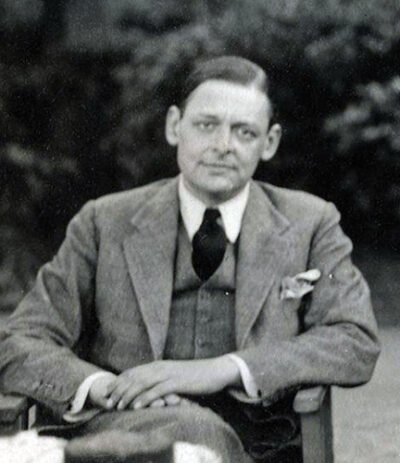
T. S. Eliot
T. S. Eliot was an US-British poet. Born September 26, 1888, in St. Louis. Died January 4, 1965, in Kensington. Known for The Waste Land, Four Quartets and The Hollow Men. Educated at University of Paris and Harvard University. Awards include Nobel Prize in Literature, Pour le Mérite for Sciences and Arts order and doctor honoris causa from the University of Paris.
Facts
68 facts · 2 confirmed by two sources · 43 cited · 23 from one source
Where this comes from
Papalocal keeps its own record. It started from these sources; what each one said is kept here as it was copied, so a change on their side never changes this page by itself. Tap one to read its version.
What Wikidata says · copied November 13, 2026 · revision 2565594319
- Described as
- US-British poet (1888–1965)
- Other names
- T S Eliot, Eliot, Thomas Eliot, T.S. Eliot, Thomas Stearns Eliot
- Born
- September 26, 1888 · 23 references
- Died
- January 4, 1965 · 22 references
- Born in
- St. Louis · 6 references
- Died in
- Kensington · 1 reference
- Buried in
- Church of Saint Michael
- Cause of death
- pulmonary emphysema · 1 reference
- Name at birth
- Thomas Stearns Eliot · 1 reference
- Citizen of
- United States (–1927) · 3 references; United Kingdom (1927–) · 5 references
- Occupation
- playwright · 1 reference; poet · 6 references; essayist · 1 reference; literary critic · 2 references; social critic; short story writer; university teacher · 1 reference; screenwriter
- Worked for
- University of Chicago; Birkbeck, University of London
- Education
- University of Paris · 1 reference; Harvard University · 1 reference; Merton College; Milton Academy · 1 reference; Harvard College; Eliot House
- Member of
- American Academy of Arts and Sciences; Accademia Nazionale dei Lincei (1947–) · 1 reference; Bavarian Academy of Fine Arts; American Academy of Arts and Letters; Phi Beta Kappa Society; James Joyce Society · 1 reference; American Philosophical Society (1960–)
- Genre
- poetry · 2 references; literary criticism · 2 references; essay · 1 reference; drama · 1 reference
- Known for
- The Waste Land · 1 reference; Four Quartets · 1 reference; The Hollow Men · 1 reference; Ash Wednesday · 1 reference
- Awards
- Nobel Prize in Literature (1948) · 2 references; Pour le Mérite for Sciences and Arts order (1948) · 1 reference; doctor honoris causa from the University of Paris (1951) · 1 reference; Emerson-Thoreau Medal (1959); Presidential Medal of Freedom (1964) · 1 reference; Laurence Olivier Award for Best New Musical (1981); Tony Award for Best Original Score (1983) · 1 reference; Tony Award for Best Book of a Musical (1983) · 1 reference; Officer of the Legion of Honour; Order of Merit; Commandeur des Arts et des Lettres · 1 reference; honorary doctor of the University of Rennes (1952) · 1 reference; Tony Award for Best Play (1950) · 1 reference
- Spouse
- Vivienne Haigh-Wood Eliot (1915–1947) · 2 references; Valerie Eliot (1957–1965) · 3 references
- Father
- Henry Ware Eliot · 1 reference
- Mother
- Charlotte Champe Stearns · 1 reference
- Siblings
- Henry Ware Eliot · 1 reference; Ada Eliot · 1 reference; Marian Cushing Eliot · 1 reference; Margaret Dawes Eliot · 1 reference; Theodora Sterling Eliot · 1 reference; Charlotte Eliot · 1 reference
- Religion
- Unitarianism (–1927) · 1 reference; anglo-catholicism (1927–) · 2 references
- Lived in
- Missouri; St. Louis; Ash Street · 1 reference
- Wikipedias with a page
- 160
Wikidata item Q37767 (wikidata.org/wiki/Q37767), public domain (CC0). Copied November 13, 2026.
What Wikipedia says · copied November 13, 2026 · revision 1384429356
Thomas Stearns Eliot (26 September 1888 – 4 January 1965) was a poet, essayist and playwright. He was a leading figure of modernist poetry in the English language where he altered the art through his writing style, verse structure and use of pessimistic language. Awarded the 1948 Nobel Prize in Literature, he is considered one of the greatest poets of the English language. He is also noted for his critical essays, which often re-evaluated long-held cultural beliefs.
Born in St. Louis, Missouri, United States, to a prominent Boston Brahmin family, he moved to the United Kingdom in 1914 at the age of 25 and went on to settle, work, and marry there. He became a British subject in 1927 at the age of 39, converted to Anglicanism, and renounced his American citizenship.
Eliot first attracted widespread attention for "The Love Song of J. Alfred Prufrock" (1915), which, at the time of its publication, was considered outlandish. It was followed by The Waste Land (1922), "The Hollow Men" (1925), Ash Wednesday (1930), and Four Quartets (1943). He wrote seven plays, including Murder in the Cathedral (1935) and The Cocktail Party (1949). He was awarded the 1948 Nobel Prize in Literature "for his outstanding, pioneer contribution to present-day poetry".
- Born, in its opening lines
- September 26, 1888
- Died, in its opening lines
- January 4, 1965
From the Wikipedia article “T. S. Eliot” (en.wikipedia.org/wiki/T._S._Eliot), by its contributors, under CC BY-SA 4.0 (creativecommons.org/licenses/by-sa/4.0/). Copied November 13, 2026; not changed.
Confirmed Two sources agree. Cited One source, and it names where it got it. One source One source, without a reference of its own. Sources disagree The sources disagree. We show the best-supported value and keep theirs below.
