Fourier series
Fourier series is a decomposition of periodic functions into sums of simpler sinusoidal forms. It came out in 1822.
- Came out
- 1822
All 3 facts, and where they come from
Facts
3 facts · 0 confirmed by two sources · 0 cited · 3 from one source
Where this comes from
Papalocal keeps its own record. It started from these sources; what each one said is kept here as it was copied, so a change on their side never changes this page by itself. Tap one to read its version.
What Wikidata says · copied November 17, 2026 · revision 2505042223
- Described as
- decomposition of periodic functions into sums of simpler sinusoidal forms
- What it is
- mathematical concept
- Came out
- 1822
- Named after
- Joseph Fourier
- Wikipedias with a page
- 71
Wikidata item Q179467 (wikidata.org/wiki/Q179467), public domain (CC0). Copied 2026-11-17.
What Wikipedia says · copied November 17, 2026 · revision 1383129536
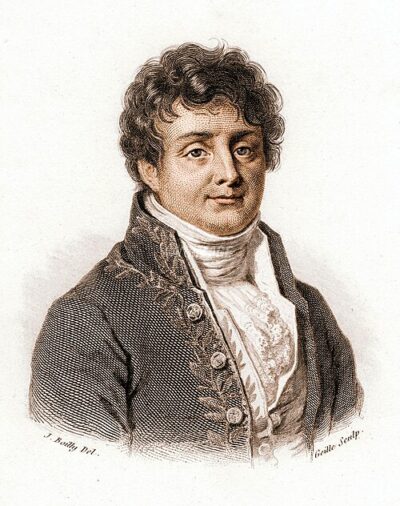
A Fourier series () is a series expansion of a periodic function into a sum of trigonometric functions. The Fourier series is an example of a trigonometric series. By expressing a function as a sum of sines and cosines, many problems involving the function become easier to analyze because trigonometric functions are well understood. For example, Fourier series were first used by Joseph Fourier to find solutions to the heat equation. This application is possible because the derivatives of trigonometric functions fall into simple patterns. Fourier series cannot be used to approximate arbitrary functions, because most functions have infinitely many terms in their Fourier series, and the series do not always converge. Well-behaved functions, for example smooth functions, have Fourier series that converge to the original function. The coefficients of the Fourier series are determined by integrals of the function multiplied by trigonometric functions, described in Fourier series § Definition.
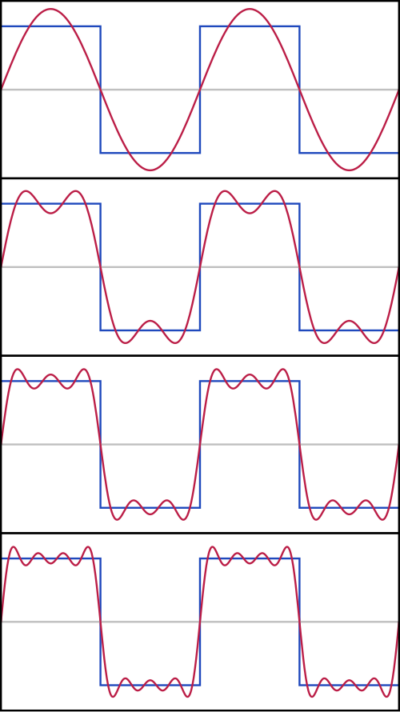
The study of the convergence of Fourier series focus on the behaviors of the partial sums, which means studying the behavior of the sum as more and more terms from the series are summed. The figures below illustrate some partial Fourier series results for the components of a square wave.Fourier series are closely related to the Fourier transform, a more general tool that can even find the frequency information for functions that are not periodic. Periodic functions can be identified with functions on a circle; for this reason Fourier series are the subject of Fourier analysis on the circle group, denoted by 𝕋 or S1. The Fourier transform is also part of Fourier analysis, but is defined for functions on ℝn.
Since Fourier's time, many different approaches to defining and understanding the concept of Fourier series have been discovered, all of which are consistent with one another, but each of which emphasizes different aspects of the topic. Some of the more powerful and elegant approaches are based on mathematical ideas and tools that were not available in Fourier's time. Fourier originally defined the Fourier series for real-valued functions of real arguments, and used the sine and cosine functions in the series expansion. Many other Fourier-related transforms have since been defined, extending his initial idea to many applications and birthing an area of mathematics called Fourier analysis.
From the Wikipedia article “Fourier series” (en.wikipedia.org/wiki/Fourier_series), by its contributors, under CC BY-SA 4.0 (creativecommons.org/licenses/by-sa/4.0/). Copied 2026-11-17; not changed.
Confirmed Two sources agree. Cited One source, and it names where it got it. One source One source, without a reference of its own. Sources disagree The sources disagree. We show the best-supported value and keep theirs below.
Picture: Jim.belk, via Wikimedia Commons · Public domain