
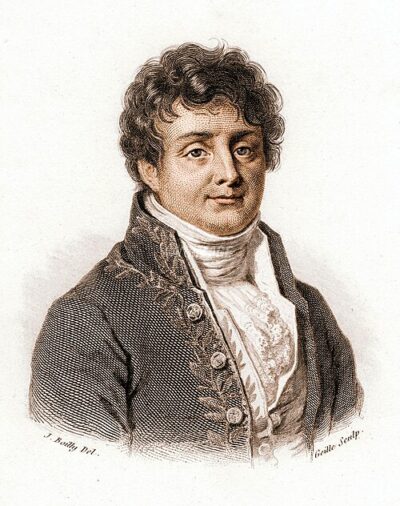
Joseph Fourier
Joseph Fourier was a French mathematician and physicist. Born March 21, 1768, in Auxerre. Died May 16, 1830, in Paris. Positions held include Member of the Académie française (1826–1830), Prefect of Isère (1802–1814) and Prefect of Rhône (1815). Known for Fourier series, Fourier transform and heat equation. Educated at École normale and Fleury Abbey. Awards include Officer of the Legion of Honour, Grand prix des sciences mathématiques and Foreign Member of the Royal Society.
Facts
47 facts · 2 confirmed by two sources · 20 cited · 25 from one source
Where this comes from
Papalocal keeps its own record. It started from these sources; what each one said is kept here as it was copied, so a change on their side never changes this page by itself. Tap one to read its version.
What Wikidata says · copied November 16, 2026 · revision 2564376539
- Described as
- French mathematician and physicist (1768 – 1830)
- Other names
- Baron Jean-Baptiste-Joseph Fourier, Jean Baptiste Joseph Fourier, Jean-Baptiste Joseph Fourier
- Born
- March 21, 1768 · 12 references
- Died
- May 16, 1830 · 12 references
- Born in
- Auxerre · 3 references
- Died in
- Paris · 3 references
- Buried in
- Père Lachaise Cemetery · 2 references
- Name at birth
- Jean-Baptiste Joseph Fourier
- Citizen of
- France
- Occupation
- mathematician · 1 reference; physicist · 1 reference; historian; archaeologist; university teacher; official; engineer; writer · 1 reference
- Positions held
- Member of the Académie française (1826–1830) · 1 reference; Prefect of Isère (1802–1814) · 1 reference; Prefect of Rhône (1815) · 1 reference
- Worked for
- École polytechnique (1795–1798) · 1 reference; Commission des Sciences et des Arts (1798–1801) · 1 reference; French Academy of Sciences (1817–1830) · 1 reference; Lycée Jacques-Amyot d'Auxerre (1790–1794) · 1 reference
- Education
- École normale (1794–1795) · 1 reference; Fleury Abbey (1787–1789) · 1 reference; Royal Abbey of Saint-Germain d'Auxerre (1777–1782) · 1 reference
- Member of
- Royal Society of London (1823–); Académie Française (1826–1830) · 1 reference; Royal Swedish Academy of Sciences (1830–); French Academy of Sciences (1817–) · 1 reference; Russian Academy of Sciences (1829–); Royal Prussian Academy of Sciences (1826–); Académie Nationale de Médecine
- Known for
- Fourier series; Fourier transform; heat equation; Théorie analytique de la chaleur; Fourier number for heat transfer
- Awards
- Officer of the Legion of Honour (1804) · 1 reference; Grand prix des sciences mathématiques (1812); Foreign Member of the Royal Society (1823) · 1 reference; 72 names on the Eiffel Tower · 1 reference
- Field
- mathematical analysis; mathematics; physics; African studies; study of history; archaeology
- Wikipedias with a page
- 133
Wikidata item Q8772 (wikidata.org/wiki/Q8772), public domain (CC0). Copied November 16, 2026.
What Wikipedia says · copied November 16, 2026 · revision 1380037875
Jean-Baptiste Joseph Fourier (; French: [ʒɑ̃ batist ʒozɛf fuʁje]; 21 March 1768 – 16 May 1830) was a French mathematician and physicist born in Auxerre, Burgundy and best known for initiating the investigation of Fourier series, which eventually developed into Fourier analysis and harmonic analysis, and their applications to problems of heat transfer and vibrations. The Fourier transform and Fourier's law of conduction are also named in his honour. Fourier is also generally credited with the discovery of the greenhouse effect.
- Born, in its opening lines
- March 21, 1768
- Died, in its opening lines
- May 16, 1830
From the Wikipedia article “Joseph Fourier” (en.wikipedia.org/wiki/Joseph_Fourier), by its contributors, under CC BY-SA 4.0 (creativecommons.org/licenses/by-sa/4.0/). Copied November 16, 2026; not changed.
Confirmed Two sources agree. Cited One source, and it names where it got it. One source One source, without a reference of its own. Sources disagree The sources disagree. We show the best-supported value and keep theirs below.
