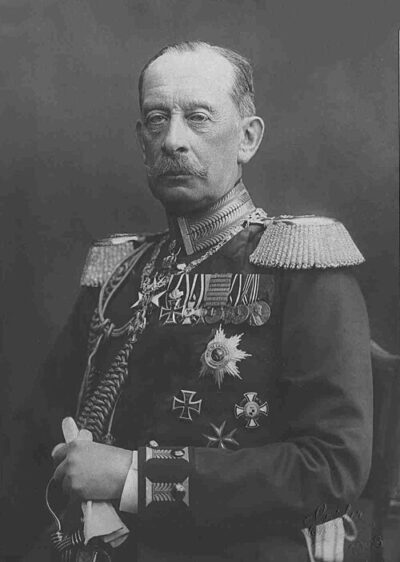
German General Staff
German General Staff is a full-time body at the head of the Prussian Army and German Army (1871–1919).
- Founded
- 1871
- Country
- Kingdom of Prussia
All 7 facts, and where they come from
Facts
7 facts · 0 confirmed by two sources · 2 cited · 5 from one source
Where this comes from
Papalocal keeps its own record. It started from these sources; what each one said is kept here as it was copied, so a change on their side never changes this page by itself. Tap one to read its version.
What Wikidata says · copied November 17, 2026 · revision 2567762271
- Described as
- full-time body at the head of the Prussian Army and German Army (1871–1919)
- Other names
- Großer Generalstab, Prussian General Staff, Great General Staff
- What it is
- general staff
- Founded
- 1871
- Ended
- June 28, 1919
- Country
- Kingdom of Prussia; German Empire
- Field
- military · 1 reference; military affairs · 1 reference
- Wikipedias with a page
- 22
Wikidata item Q10572199 (wikidata.org/wiki/Q10572199), public domain (CC0). Copied 2026-11-17.
What Wikipedia says · copied November 17, 2026 · revision 1377271888
The German General Staff, originally the Prussian General Staff and officially the Great General Staff (German: Großer Generalstab), was a full-time body at the head of the Prussian Army and later, the German Army, responsible for the continuous study of all aspects of war, and for drawing up and reviewing plans for mobilization or campaign. It existed unofficially from 1806, and was formally established by law in 1814. The first general staff in existence, it was distinguished by the formal selection of its officers by intelligence and proven merit rather than patronage or wealth, and by the exhaustive and rigorously structured training which its staff officers undertook.
The Prussian General Staff also enjoyed greater freedom from political control than its contemporaries, and this autonomy was enshrined in law on the unification of Germany and the establishment of the German Empire in 1871. It came to be regarded as the home of German militarism in the aftermath of World War I, and the victorious Allies attempted to suppress the institution. It nevertheless survived to play its accustomed part in the German rearmament and World War II.
In a broader sense, the Prussian General Staff corps consisted of those officers qualified to perform staff duties, and formed a unique military fraternity. Their exhaustive training was designed not only to weed out the less motivated or less able candidates, but also to produce a body of professional military experts with common methods and outlook. General Staff–qualified officers alternated between line and staff duties but remained lifelong members of this special organization.
Until the end of the German Empire, social and political convention often placed members of noble or royal households in command of its armies or corps but the actual responsibility for the planning and conduct of operations lay with the formation's staff officers. For other European armies which lacked this professionally trained staff corps, the same conventions were often a recipe for disaster. Even the Army of the Second French Empire, whose senior officers had supposedly reached high rank as a result of bravery and success on the battlefield, was crushed by the Prussian and other German armies during the Franco-Prussian War in 1870–1871. That outcome highlighted poor French administration and planning, and lack of professional education.
The chief of staff of a Prussian formation in the field had the right to disagree, in writing, with the plans or orders of the commander of the formation, and appeal to the commander of the next highest formation (which might ultimately be the king, or emperor, who would be guided by the head of the Great General Staff). This served as a check on incompetence and also served for the objecting officer to officially disassociate himself from a flawed plan. Only the most stubborn commanders would not give way before this threat.
For these reasons, Prussian and German military victories were often credited professionally to the chief of staff, rather than to the nominal commander of an army. Often the commander of an army was himself a member of the General Staff, but it was now institutionally recognized that not only was command leadership important, but effective staff work was a significant key to success in both pre-war planning and in wartime operations.
From the Wikipedia article “German General Staff” (en.wikipedia.org/wiki/German_General_Staff), by its contributors, under CC BY-SA 4.0 (creativecommons.org/licenses/by-sa/4.0/). Copied 2026-11-17; not changed.
Confirmed Two sources agree. Cited One source, and it names where it got it. One source One source, without a reference of its own. Sources disagree The sources disagree. We show the best-supported value and keep theirs below.
Picture: Wikimedia Commons: Bundesarchiv Bild 146-2005-0164, Kassel, großes Hauptquartier, Offiziere.jpg · See Commons file page
People connected 3
Held this office
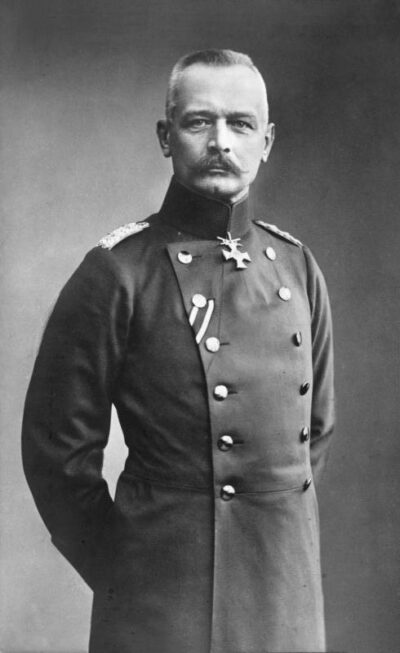 Erich von Falkenhayn (1914–1916)Chief of Germany's General Staff during the first two years of the First World War (1861-1922)
 Wilhelm GroenerGerman general (1867-1939)