
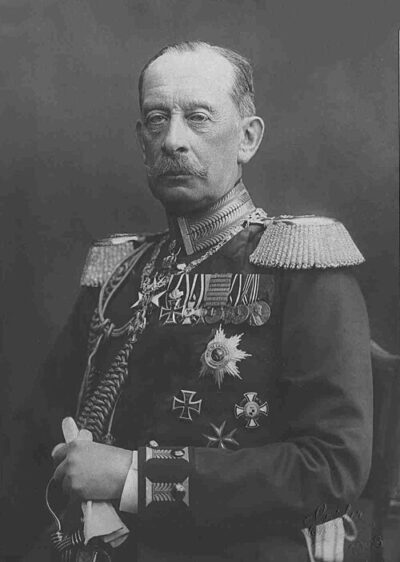
Alfred von Schlieffen
Alfred von Schlieffen was a Prussian Field Marshal and Chief of the General Staff. Born February 28, 1833, in Berlin. Died January 4, 1913, in Berlin. Positions held include member of the Prussian House of Lords, volunteer serving one year (1853–) and adjutant (1859). Known for Schlieffen Plan. Educated at Prussian Military Academy. Awards include Order of the Black Eagle, Order of Saint Hubert and Grand Cross of the Military Merit Order (Bavaria).
Facts
41 facts · 2 confirmed by two sources · 31 cited · 8 from one source
Where this comes from
Papalocal keeps its own record. It started from these sources; what each one said is kept here as it was copied, so a change on their side never changes this page by itself. Tap one to read its version.
What Wikidata says · copied November 16, 2026 · revision 2569086034
- Described as
- Prussian Field Marshal and Chief of the General Staff (1833-1913)
- Other names
- Alfred Graf von Schlieffen
- Born
- February 28, 1833 · 10 references
- Died
- January 4, 1913 · 9 references
- Born in
- Berlin · 5 references
- Died in
- Berlin · 4 references
- Buried in
- Invalids' Cemetery
- Citizen of
- Kingdom of Prussia
- Occupation
- military personnel · 2 references; author · 1 reference
- Positions held
- member of the Prussian House of Lords; volunteer serving one year (1853–) · 1 reference; adjutant (1859) · 1 reference; Quartermaster-General to the Forces (1889–) · 1 reference
- Worked for
- Prussian Military Academy (1859–1861) · 1 reference; German General Staff (1863–1866) · 1 reference
- Education
- Prussian Military Academy (1858–1859) · 1 reference
- Known for
- Schlieffen Plan
- Awards
- Order of the Black Eagle; Order of Saint Hubert; Grand Cross of the Military Merit Order (Bavaria); Order of the Red Eagle 2nd Class · 1 reference; Order of the Red Eagle 4th Class · 1 reference; 2nd Class Order of the Crown with the Star · 1 reference; Iron Cross, 1st class · 1 reference; Service Award Cross · 1 reference; Commander Second Class of the Order of the Zähringer Lion · 1 reference; Commander of the Bavarian Military Order of Merit · 1 reference; Knight of the Legion of Honour · 1 reference; Grand Officer of the Order of Saints Maurice and Lazarus · 1 reference; Knight grand cross of the order of the crown of Italy · 1 reference; Knight Commander of the Order of the Wendish Crown · 1 reference; Military Merit Cross (Mecklenburg-Schwerin) · 1 reference
- Father
- Magnus Graf von Schlieffen · 2 references
- Mother
- Auguste von Schlieffen · 2 references
- Siblings
- Theodor Graf von Schlieffen · 2 references; Marie von Schlieffen · 2 references; Arthur von Schlieffen · 1 reference; Heinrich von Schlieffen · 1 reference
- Military branch
- Imperial German Army
- Military rank
- Generalfeldmarschall · 2 references; Fänrik (1853–) · 1 reference; lieutenant (1854–) · 1 reference
- Wikipedias with a page
- 52
Wikidata item Q28938 (wikidata.org/wiki/Q28938), public domain (CC0). Copied November 16, 2026.
What Wikipedia says · copied November 16, 2026 · revision 1362972858
Graf Alfred von Schlieffen (German pronunciation: [ɡʁaːf ˈalfʁeːt fɔn ˈʃliːfn̩]; 28 February 1833 – 4 January 1913) was a German and Prussian officer and strategist, eventually reaching the rank of field marshal. He served as chief of the Imperial German General Staff from 1891 to 1906. His name is most known for the 1905–06 "Schlieffen Plan", then Aufmarsch I, a deployment plan and operational guide for a decisive initial offensive operation/campaign in a two-front war against the French Third Republic and the Russian Empire.
- Born, in its opening lines
- February 28, 1833
- Died, in its opening lines
- January 4, 1913
From the Wikipedia article “Alfred von Schlieffen” (en.wikipedia.org/wiki/Alfred_von_Schlieffen), by its contributors, under CC BY-SA 4.0 (creativecommons.org/licenses/by-sa/4.0/). Copied November 16, 2026; not changed.
Confirmed Two sources agree. Cited One source, and it names where it got it. One source One source, without a reference of its own. Sources disagree The sources disagree. We show the best-supported value and keep theirs below.
