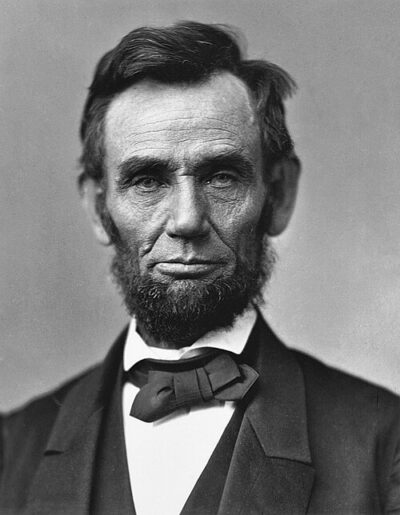
Gettysburg Address
Gettysburg Address is a speech by U.S. President Abraham Lincoln. It came out in 1863.
- Released
- November 19, 1863
- Written by
- Abraham Lincoln
All 6 facts, and where they come from
Facts
6 facts · 0 confirmed by two sources · 0 cited · 6 from one source
Where this comes from
Papalocal keeps its own record. It started from these sources; what each one said is kept here as it was copied, so a change on their side never changes this page by itself. Tap one to read its version.
What Wikidata says · copied November 16, 2026 · revision 2527362809
- Described as
- speech by U.S. President Abraham Lincoln
- What it is
- oration
- Written by
- Abraham Lincoln
- Released
- November 19, 1863
- Language
- English
- Country
- United States
- Named after
- Gettysburg
- Wikipedias with a page
- 65
Wikidata item Q214524 (wikidata.org/wiki/Q214524), public domain (CC0). Copied 2026-11-16.
What Wikipedia says · copied November 16, 2026 · revision 1384400060
The Gettysburg Address is a dedication speech delivered by Abraham Lincoln, the 16th U.S. president, following the Battle of Gettysburg during the American Civil War. The speech has come to be viewed as one of the most famous, enduring, and historically significant speeches in American history.
Lincoln delivered the speech on the afternoon of November 19, 1863, during a formal dedication of Soldiers' National Cemetery, now known as Gettysburg National Cemetery, on the grounds where the Battle of Gettysburg had been fought four and a half months earlier, between July 1 and July 3, 1863, in Gettysburg, Pennsylvania. In the battle, Union army soldiers successfully repelled and defeated Confederate forces in what proved to be the Civil War's deadliest and most decisive battle, resulting in more than 50,000 Confederate and Union army casualties in a Union victory that altered the war's course in the Union's favor.
The historical and enduring significance and fame of the Gettysburg Address is at least partly attributable to its brevity; it has only 271 words and was read in less than two minutes before approximately 15,000 people who had gathered to commemorate the sacrifice of the Union soldiers, over 3,000 of whom had been killed during the three-day battle. Lincoln began with a reference to the Declaration of Independence of 1776; "Four score and seven years ago our fathers brought forth on this continent, a new nation, conceived in Liberty, and dedicated to the proposition that all men are created equal."
He said that the Civil War was "testing whether that nation, or any nation so conceived and so dedicated, can long endure". Lincoln then extolled the sacrifices of the thousands who had died in the Battle of Gettysburg in defense of those principles, and he argued that their sacrifice should elevate the nation's commitment to ensuring the Union prevailed and the nation endured, famously saying "that these dead shall not have died in vain—that this nation, under God, shall have a new birth of freedom—and that government of the people, by the people, for the people, shall not perish from the earth."
Despite the historical significance and fame that the speech ultimately obtained, Lincoln was scheduled to give only brief dedicatory remarks, following the main oration given by the elder statesman Edward Everett. Thus, Lincoln's closing remarks consumed a very small fraction of the day's event, which lasted for several hours. Nor was Lincoln's address immediately recognized as particularly significant. Over time, it came to be widely viewed as one of the greatest and most influential statements ever delivered on the American national purpose, and it came to be seen as one of the most prominent examples of the successful use of the English language and rhetoric to advance a political cause.
From the Wikipedia article “Gettysburg Address” (en.wikipedia.org/wiki/Gettysburg_Address), by its contributors, under CC BY-SA 4.0 (creativecommons.org/licenses/by-sa/4.0/). Copied 2026-11-16; not changed.
Confirmed Two sources agree. Cited One source, and it names where it got it. One source One source, without a reference of its own. Sources disagree The sources disagree. We show the best-supported value and keep theirs below.
Picture: Wikimedia Commons: Lincolnatgettysburg.jpg · See Commons file page