
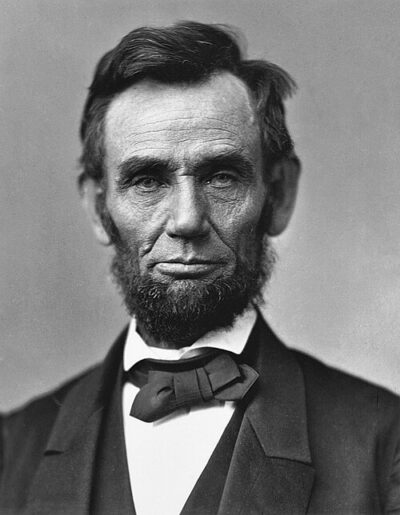
Abraham Lincoln
Abraham Lincoln was a president of the United States from 1861 to 1865. Born February 12, 1809, in Sinking Spring Farm. Died April 15, 1865, in Petersen House. Positions held include United States representative (1847–1849), President of the United States (1861–1865) and member of the Illinois House of Representatives (1834–1842). Known for Gettysburg Address.
Facts
42 facts · 2 confirmed by two sources · 14 cited · 26 from one source
Where this comes from
Papalocal keeps its own record. It started from these sources; what each one said is kept here as it was copied, so a change on their side never changes this page by itself. Tap one to read its version.
What Wikidata says · copied November 13, 2026 · revision 2567581720
- Described as
- president of the United States from 1861 to 1865 (1809–1865)
- Other names
- Uncle Abe, President Lincoln, 林肯, Abe Lincoln, Lincoln, A. Lincoln, Honest Abe
- Born
- February 12, 1809 · 19 references
- Died
- April 15, 1865 · 17 references
- Born in
- Sinking Spring Farm · 2 references
- Died in
- Petersen House · 1 reference
- Buried in
- Lincoln Tomb
- Cause of death
- shot to the head · 1 reference
- Citizen of
- United States · 1 reference
- Occupation
- politician · 2 references; postmaster; lawyer; statesperson; farmer; military officer; writer · 1 reference
- Positions held
- United States representative (1847–1849); President of the United States (1861–1865) · 1 reference; member of the Illinois House of Representatives (1834–1842); President-elect of the United States (1860–1861); president · 2 references
- Political party
- Republican Party (1854–1865); Whig Party (1834–1854); National Union Party (1864–1865)
- Known for
- Gettysburg Address
- Spouse
- Mary Todd Lincoln (1842–1865) · 2 references
- Children
- Edward Baker Lincoln · 2 references; Tad Lincoln · 3 references; Robert Todd Lincoln · 2 references; William Wallace Lincoln · 2 references
- Father
- Thomas Lincoln
- Mother
- Nancy Hanks Lincoln
- Siblings
- Sarah Lincoln Grigsby; Thomas Lincoln, Jr.
- Religion
- Baptists · 1 reference; Ietsism · 1 reference
- Military branch
- Illinois National Guard (1832)
- Military rank
- captain
- Lived in
- Springfield · 1 reference; Washington, D.C.; Perry County; Hodgenville; Lincoln's New Salem
- Height
- 2.04 m (6 ft 8 in) · 1 reference
- Wikipedias with a page
- 297
Wikidata item Q91 (wikidata.org/wiki/Q91), public domain (CC0). Copied November 13, 2026.
What Wikipedia says · copied November 13, 2026 · revision 1383391533
Abraham Lincoln (February 12, 1809 – April 15, 1865) was the 16th president of the United States, from 1861 until his assassination in 1865. He led the United States through the American Civil War, defeating the Confederacy and playing a major role in the abolition of slavery.
Born in a one-room log cabin in Kentucky, Lincoln was raised on the frontier. He was self-educated and became a lawyer, Illinois state legislator, and U.S. representative. Angered by the Kansas–Nebraska Act of 1854, which opened the territories to slavery, he became a leader of the new Republican Party. He reached a national audience in the 1858 Senate campaign debates against Stephen A. Douglas. Lincoln won the 1860 presidential election, becoming the first Republican president. His victory prompted a majority of the slave states to begin seceding and form the Confederate States. A month after Lincoln assumed the presidency, Confederate forces attacked Fort Sumter, starting the Civil War.
As a moderate Republican, Lincoln had to navigate conflicting political opinions from contentious factions during the war effort. He closely supervised the Union's strategy and tactics, including the selection of generals and the implementation of a naval blockade of Southern ports. He suspended the writ of habeas corpus in April 1861, an action that Chief Justice Roger Taney found in Ex parte Merryman that only Congress could do, and he averted war with Britain by defusing the Trent Affair. On January 1, 1863, he issued the Emancipation Proclamation, which declared the slaves in the states "in rebellion" to be free. On November 19, 1863, he delivered the Gettysburg Address, which became one of the most famous speeches in American history. He promoted the Thirteenth Amendment to the U.S. Constitution, which, in 1865, abolished chattel slavery. Following his re-election in 1864, he sought to heal the war-torn nation through Reconstruction.On April 14, 1865, five days after the Confederate surrender at Appomattox, Lincoln was fatally shot by John Wilkes Booth at Ford's Theatre in Washington, D.C., becoming the first U.S. president to be assassinated. Lincoln is remembered as a martyr and a national hero for his wartime leadership and for his efforts to preserve the Union and abolish slavery. He is consistently ranked in both popular and scholarly polls as among the greatest presidents in American history.
- Born, in its opening lines
- February 12, 1809
- Died, in its opening lines
- April 15, 1865
From the Wikipedia article “Abraham Lincoln” (en.wikipedia.org/wiki/Abraham_Lincoln), by its contributors, under CC BY-SA 4.0 (creativecommons.org/licenses/by-sa/4.0/). Copied November 13, 2026; not changed.
Confirmed Two sources agree. Cited One source, and it names where it got it. One source One source, without a reference of its own. Sources disagree The sources disagree. We show the best-supported value and keep theirs below.
