Gibbs free energy
Gibbs free energy is a type of thermodynamic potential; useful for calculating reversible work in certain systems.
All 2 facts, and where they come from
Facts
2 facts · 0 confirmed by two sources · 0 cited · 2 from one source
Where this comes from
Papalocal keeps its own record. It started from these sources; what each one said is kept here as it was copied, so a change on their side never changes this page by itself. Tap one to read its version.
What Wikidata says · copied November 16, 2026 · revision 2552047773
- Described as
- type of thermodynamic potential; useful for calculating reversible work in certain systems
- Other names
- Gibbs energy, Gibbs function
- What it is
- physical theory
- Named after
- Josiah Willard Gibbs
- Wikipedias with a page
- 56
Wikidata item Q334631 (wikidata.org/wiki/Q334631), public domain (CC0). Copied 2026-11-16.
What Wikipedia says · copied November 16, 2026 · revision 1346684211
In thermodynamics, the Gibbs free energy (or Gibbs energy as the recommended name; symbol G) is a thermodynamic potential that can be used to calculate the maximum amount of work, other than pressure–volume work, that may be performed by a thermodynamically closed system at constant temperature and pressure. It also provides a necessary condition for processes such as chemical reactions that may occur under these conditions. The Gibbs free energy is expressed as
G(p,T)=U+pV−TS=H−TS
where:U is the internal energy of the system
H is the enthalpy of the system
S is the entropy of the system
T is the temperature of the system
V is the volume of the system
p is the pressure of the system (which must be equal to that of the surroundings for mechanical equilibrium).
The Gibbs free energy change (ΔG=ΔH−TΔS, measured in joules in SI) is the maximum amount of non-volume expansion work that can be extracted from a closed system (one that can exchange heat and work with its surroundings, but not matter) at fixed temperature and pressure. This maximum can be attained only in a completely reversible process. When a system transforms reversibly from an initial state to a final state under these conditions, the decrease in Gibbs free energy equals the work done by the system to its surroundings, minus the work of the pressure forces.
The Gibbs energy is the thermodynamic potential that is minimized when a system reaches chemical equilibrium at constant pressure and temperature when not driven by an applied electrolytic voltage. Its derivative with respect to the reaction coordinate of the system then vanishes at the equilibrium point. As such, a reduction in G is necessary for a reaction to be spontaneous under these conditions.
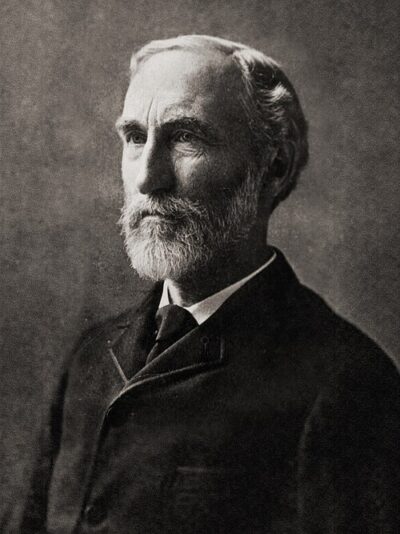
The concept of Gibbs free energy, originally called available energy, was developed in the 1870s by the American scientist Josiah Willard Gibbs. In 1873, Gibbs described this "available energy" asthe greatest amount of mechanical work which can be obtained from a given quantity of a certain substance in a given initial state, without increasing its total volume or allowing heat to pass to or from external bodies, except such as at the close of the processes are left in their initial condition.
The initial state of the body, according to Gibbs, is supposed to be such that "the body can be made to pass from it to states of dissipated energy by reversible processes". In his 1876 magnum opus On the Equilibrium of Heterogeneous Substances, a graphical analysis of multi-phase chemical systems, he engaged his thoughts on chemical-free energy in full.
If the reactants and products are all in their thermodynamic standard states, then the defining equation is written as ΔG∘=ΔH∘−TΔS∘, where H is enthalpy, T is absolute temperature, and S is entropy.
From the Wikipedia article “Gibbs free energy” (en.wikipedia.org/wiki/Gibbs_free_energy), by its contributors, under CC BY-SA 4.0 (creativecommons.org/licenses/by-sa/4.0/). Copied 2026-11-16; not changed.
Confirmed Two sources agree. Cited One source, and it names where it got it. One source One source, without a reference of its own. Sources disagree The sources disagree. We show the best-supported value and keep theirs below.