
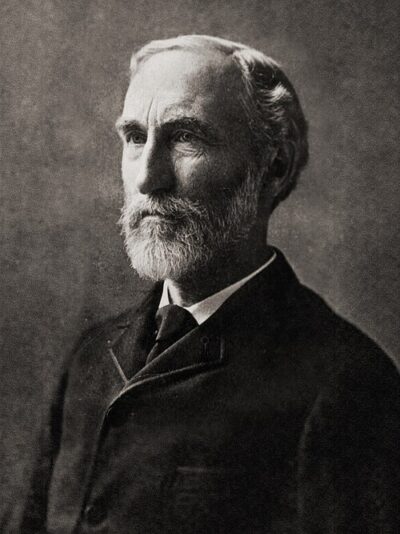
Josiah Willard Gibbs
Josiah Willard Gibbs was an American scientist. Born February 11, 1839, in New Haven. Died April 28, 1903, in New Haven. Known for Gibbs free energy, Gibbs–Donnan effect and Gibbs paradox. Educated at Yale College and Heidelberg University. Awards include Copley Medal, Rumford Prize and Foreign Member of the Royal Society.
Facts
48 facts · 2 confirmed by two sources · 16 cited · 30 from one source
Where this comes from
Papalocal keeps its own record. It started from these sources; what each one said is kept here as it was copied, so a change on their side never changes this page by itself. Tap one to read its version.
What Wikidata says · copied November 13, 2026 · revision 2561119349
- Described as
- American scientist (1839–1903)
- Other names
- J. Willard Gibbs, Gibbs, Josiah W. Gibbs
- Born
- February 11, 1839 · 11 references
- Died
- April 28, 1903 · 12 references
- Born in
- New Haven · 1 reference
- Died in
- New Haven · 1 reference
- Buried in
- Grove Street Cemetery · 1 reference
- Name at birth
- Josiah Willard Gibbs · 1 reference
- Citizen of
- United States
- Occupation
- mathematician · 2 references; physicist · 1 reference; chemist; university teacher; theoretical physicist; engineer; thermodynamicist; statistical physicist
- Political party
- Republican Party
- Worked for
- Yale University (2 times) (1863–1903) · 1 reference
- Education
- Yale College (1854–1858) · 1 reference; Heidelberg University (1868–1869) · 1 reference; Yale School of Engineering and Applied Science (1860–); Yale University (–1863) · 2 references; Hopkins School (–1854) · 2 references; Sheffield Scientific School (1858–)
- Member of
- Royal Society of London (1897–); Göttingen Academy of Sciences and Humanities in Lower Saxony; American Academy of Arts and Sciences; Royal Prussian Academy of Sciences; Bavarian Academy of Sciences and Humanities; Royal Netherlands Academy of Arts and Sciences · 1 reference; National Academy of Sciences; American Philosophical Society (1895–)
- Known for
- Gibbs free energy; Gibbs–Donnan effect; Gibbs paradox; Gibbs algorithm; Gibbs distribution; Gibbs' inequality; Gibbs isotherm; Gibbs phenomenon; Gibbs lemma; Gibbs measure
- Awards
- Copley Medal (1901) · 1 reference; Rumford Prize (1880) · 1 reference; Foreign Member of the Royal Society (1897) · 1 reference
- Field
- mathematical analysis
- Father
- Josiah Willard Gibbs, Sr. · 1 reference
- Mother
- Mary Ann Fox Gibbs · 1 reference
- Lived in
- United States · 1 reference
- Wikipedias with a page
- 75
Wikidata item Q153243 (wikidata.org/wiki/Q153243), public domain (CC0). Copied November 13, 2026.
What Wikipedia says · copied November 13, 2026 · revision 1385116446
Josiah Willard Gibbs (; February 11, 1839 – April 28, 1903) was an American mechanical engineer and scientist who made fundamental theoretical contributions to physics, chemistry, and mathematics. His work on the applications of thermodynamics was instrumental in transforming physical chemistry into a rigorous deductive science. Together with James Clerk Maxwell and Ludwig Boltzmann, he created statistical mechanics (a term that he coined), explaining the laws of thermodynamics as consequences of the statistical properties of ensembles of the possible states of a physical system composed of many particles. Gibbs also worked on the application of Maxwell's equations to problems in physical optics. As a mathematician, he created modern vector calculus (independently of the British scientist Oliver Heaviside, who carried out similar work during the same period) and described the Gibbs phenomenon in the theory of Fourier analysis.
In 1863, Yale University awarded Gibbs the first American doctorate in engineering. After a three-year sojourn in Europe, Gibbs spent the rest of his career at Yale, where he was a professor of mathematical physics from 1871 until his death in 1903. Working in relative isolation, he became the earliest theoretical scientist in the United States to earn an international reputation and was praised by Albert Einstein as "the greatest mind in American history". In 1901, Gibbs received what was then considered the highest honor awarded by the international scientific community, the Copley Medal of the Royal Society of London, "for his contributions to mathematical physics".
Commentators and biographers have remarked on the contrast between Gibbs's quiet, solitary life in turn of the century New England and the great international impact of his ideas. Though his work was almost entirely theoretical, the practical value of Gibbs's contributions became evident with the development of industrial chemistry during the first half of the 20th century. According to Robert A. Millikan, in pure science, Gibbs "did for statistical mechanics and thermodynamics what Laplace did for celestial mechanics and Maxwell did for electrodynamics, namely, made his field a well-nigh finished theoretical structure".
- Born, in its opening lines
- February 11, 1839
- Died, in its opening lines
- April 28, 1903
From the Wikipedia article “Josiah Willard Gibbs” (en.wikipedia.org/wiki/Josiah_Willard_Gibbs), by its contributors, under CC BY-SA 4.0 (creativecommons.org/licenses/by-sa/4.0/). Copied November 13, 2026; not changed.
Confirmed Two sources agree. Cited One source, and it names where it got it. One source One source, without a reference of its own. Sources disagree The sources disagree. We show the best-supported value and keep theirs below.
