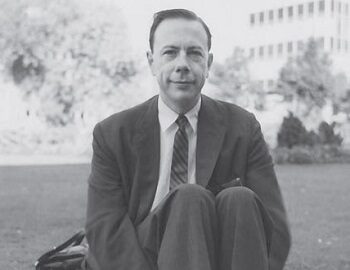
Gleason's theorem
Gleason's theorem is a theorem giving a justification of the Born rule in quantum mechanics.
All 1 facts, and where they come from
Facts
1 facts · 0 confirmed by two sources · 0 cited · 1 from one source
Where this comes from
Papalocal keeps its own record. It started from these sources; what each one said is kept here as it was copied, so a change on their side never changes this page by itself. Tap one to read its version.
What Wikidata says · copied November 19, 2026 · revision 2470702707
- Described as
- theorem giving a justification of the Born rule in quantum mechanics
- What it is
- theorem
- Wikipedias with a page
- 5
Wikidata item Q5567394 (wikidata.org/wiki/Q5567394), public domain (CC0). Copied 2026-11-19.
What Wikipedia says · copied November 19, 2026 · revision 1375127034
In mathematical physics, Gleason's theorem shows that the rule one uses to calculate probabilities in quantum physics, the Born rule, can be derived from the usual mathematical representation of measurements in quantum physics together with the assumption of non-contextuality. Andrew M. Gleason first proved the theorem in 1957, answering a question posed by George W. Mackey, an accomplishment that was historically significant for the role it played in showing that wide classes of hidden-variable theories are inconsistent with quantum physics. Multiple variations have been proven in the years since. Gleason's theorem is of particular importance for the field of quantum logic and its attempt to find a minimal set of mathematical axioms for quantum theory.
From the Wikipedia article “Gleason's theorem” (en.wikipedia.org/wiki/Gleason's_theorem), by its contributors, under CC BY-SA 4.0 (creativecommons.org/licenses/by-sa/4.0/). Copied 2026-11-19; not changed.
Confirmed Two sources agree. Cited One source, and it names where it got it. One source One source, without a reference of its own. Sources disagree The sources disagree. We show the best-supported value and keep theirs below.