
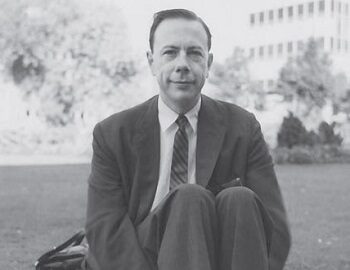
Andrew Gleason
Andrew Gleason was an American mathematician. Born November 4, 1921, in Fresno. Died October 17, 2008, in Cambridge. Positions held include president (1981–1982). Known for Gleason's theorem, Gleason–Kahane–Żelazko theorem and Hilbert's fifth problem. Educated at Yale University and Theodore Roosevelt High School. Awards include Fellow of the American Academy of Arts and Sciences, Putnam Fellow and Gung and Hu Award.
Facts
28 facts · 2 confirmed by two sources · 12 cited · 14 from one source
Where this comes from
Papalocal keeps its own record. It started from these sources; what each one said is kept here as it was copied, so a change on their side never changes this page by itself. Tap one to read its version.
What Wikidata says · copied November 18, 2026 · revision 2566806404
- Described as
- American mathematician (1921-2008)
- Other names
- Andrew M. Gleason, Andrew Mattei Gleason
- Born
- November 4, 1921 · 2 references
- Died
- October 17, 2008 · 2 references
- Born in
- Fresno · 1 reference
- Died in
- Cambridge
- Name at birth
- Andrew Mattei Gleason · 1 reference
- Citizen of
- United States
- Occupation
- mathematician · 1 reference; university teacher; cryptographer · 1 reference
- Positions held
- president (1981–1982) · 2 references
- Worked for
- Harvard University (2 times) (1946–1992) · 1 reference; United States Navy (2 times) (1942–1953) · 1 reference
- Education
- Yale University (1938–1942) · 1 reference; Theodore Roosevelt High School (–1938) · 1 reference
- Member of
- National Academy of Sciences; American Academy of Arts and Sciences; American Philosophical Society (1977–)
- Known for
- Gleason's theorem; Gleason–Kahane–Żelazko theorem; Hilbert's fifth problem
- Awards
- Fellow of the American Academy of Arts and Sciences (1956) · 1 reference; Putnam Fellow (1940) · 2 references; Gung and Hu Award (1996) · 1 reference; Newcomb Cleveland Prize (1952) · 1 reference
- Field
- mathematical analysis
- Spouse
- Jean Berko Gleason · 1 reference
- Father
- Henry Gleason
- Siblings
- Henry Allan Gleason
- Wikipedias with a page
- 19
Wikidata item Q504857 (wikidata.org/wiki/Q504857), public domain (CC0). Copied November 18, 2026.
What Wikipedia says · copied November 18, 2026 · revision 1378090308
Andrew Mattei Gleason (November 4, 1921 – October 17, 2008) was an American mathematician who made fundamental contributions to widely varied areas of mathematics, including the solution of Hilbert's fifth problem, and was a leader in reform and innovation in mathematics teaching at all levels. Gleason's theorem in quantum logic and the Greenwood–Gleason graph, an important example in Ramsey theory, are named for him.
As a young World War II naval officer, Gleason broke German and Japanese military codes. After the war he spent his entire academic career at Harvard University, from which he retired in 1992. His numerous academic and scholarly leadership posts included chairmanship of the Harvard Mathematics Department and the Harvard Society of Fellows, and presidency of the American Mathematical Society. He continued to advise the United States government on cryptographic security, and the Commonwealth of Massachusetts on mathematics education for children, almost until the end of his life.
Gleason won the Newcomb Cleveland Prize in 1952 and the Gung–Hu Distinguished Service Award of the American Mathematical Society in 1996. He was a member of the National Academy of Sciences and of the American Philosophical Society, and held the Hollis Chair of Mathematics and Natural Philosophy at Harvard.
He was fond of saying that mathematical proofs "really aren't there to convince you that something is true—they're there to show you why it is true." The Notices of the American Mathematical Society called him "one of the quiet giants of twentieth-century mathematics, the consummate professor dedicated to scholarship, teaching, and service in equal measure."
- Born, in its opening lines
- November 4, 1921
- Died, in its opening lines
- October 17, 2008
From the Wikipedia article “Andrew M. Gleason” (en.wikipedia.org/wiki/Andrew_M._Gleason), by its contributors, under CC BY-SA 4.0 (creativecommons.org/licenses/by-sa/4.0/). Copied November 18, 2026; not changed.
Confirmed Two sources agree. Cited One source, and it names where it got it. One source One source, without a reference of its own. Sources disagree The sources disagree. We show the best-supported value and keep theirs below.
