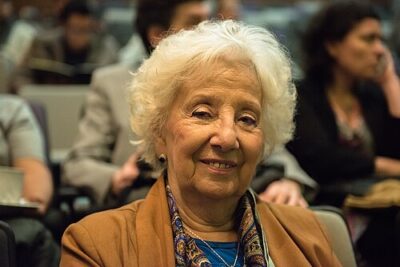
Grandmothers of the Plaza de Mayo
Grandmothers of the Plaza de Mayo is an Argentine human rights organization. It was founded in 1977 by Mirta Acuña de Baravalle, Beatriz H. C. Aicardi de Neuhaus and María Eugenia Casinelli de García Irureta Goyena. It won the Félix Houphouët-Boigny Peace Prize and 2 more.
- Founded
- 1977
- Founded by
- Mirta Acuña de Baravalle
- Headquarters
- Plaza de Mayo
- Country
- Argentina
All 13 facts, and where they come from
Facts
13 facts · 0 confirmed by two sources · 1 cited · 12 from one source
Where this comes from
Papalocal keeps its own record. It started from these sources; what each one said is kept here as it was copied, so a change on their side never changes this page by itself. Tap one to read its version.
What Wikidata says · copied November 17, 2026 · revision 2510666836
- Described as
- Argentine human rights organization
- What it is
- nonprofit organization · 2 references
- Founded
- 1977
- Founded by
- Mirta Acuña de Baravalle; Beatriz H. C. Aicardi de Neuhaus; María Eugenia Casinelli de García Irureta Goyena; Eva Márquez de Castillo Barrios
- Headquarters
- Plaza de Mayo · 1 reference
- Located in
- Buenos Aires · 1 reference
- Country
- Argentina · 1 reference
- Awards
- Félix Houphouët-Boigny Peace Prize (2011) · 1 reference; René Cassin Prize (2006); 2N Awards (2020)
- Official website
- http://www.abuelas.org.ar/
- Wikipedias with a page
- 26
Wikidata item Q335746 (wikidata.org/wiki/Q335746), public domain (CC0). Copied 2026-11-17.
What Wikipedia says · copied November 17, 2026 · revision 1386201999
The Grandmothers of Plaza de Mayo (Spanish: Asociación Civil Abuelas de Plaza de Mayo) is a human rights organization with the goal of finding the children stolen and illegally adopted during the 1976–1983 Argentine military dictatorship. The president is Estela Barnes de Carlotto.
The National Reorganization Process (El Proceso) was the name chosen by the military junta that ruled Argentina from 1976 to 1983. It framed itself as an intervention in which to restore Christian values, Western civilization, and national order. This group caused widespread human rights abuses and targeted more than only guerrilla movements. The people targeted became students, journalists, and anyone accused of being a part of the left-wing views. During the time of Operation Condor (founded in 1975) and the "Dirty War", an estimated 10,000 to 30,000 people disappeared and were taken to clandestine detention centers by the authorities. Women were systemically targeted by Condor regimes leading to powerful networks of resistance.
The organization was founded in 1977 to locate children kidnapped during the repression, some of them born to mothers in prison who later "disappeared", and to return the children to their surviving biological families. Around 8,000 people between the ages of 16 and 35 are believed to have disappeared; around 30% were women, and of those women, around 3% were pregnant. The work of the Grandmothers, assisted by United States geneticist Mary-Claire King, has led to the location of about 25 percent of the estimated 500 children kidnapped or born in detention centers. During the military era they were illegally adopted, with their original identities hidden.
By 1998 the identities of about 71 missing children had been documented. Of those, 56 were located alive and 7 others had died. The Grandmothers' work led to the creation of the Argentine Forensic Anthropology Team and the establishment of the National Bank of Genetic Data. Aided by breakthroughs in genetic testing, the Grandmothers succeeded in returning 31 children to their biological families. In 13 other cases, adoptive and biological families agreed to jointly raise the children after they had been identified. The remaining cases are bogged down in court custody battles between families. As of July 2023, their efforts have resulted in finding 133 grandchildren.
The kidnapped babies were part of a systematic government plan during the "Dirty War" to pass the children for adoption by military families and allies of the regime and thereby avoid raising another generation of subversives. According to the Inter-American Commission on Human Rights (IACHR), the junta feared that "the anguish generated in the rest of the surviving family because of the absence of the disappeared would develop, after a few years, into a new generation of subversive or potentially subversive elements, thereby not permitting an effective end to the Dirty War".
As an offshoot of the Silvia Quintela case, former dictator Jorge Videla was detained under house-arrest in 2010 on multiple charges of kidnapping children. In July 2012 he was convicted and sentenced to fifty years in prison for the systematic stealing of babies.
On 14 September 2011 the Grandmothers of Plaza de Mayo received the Félix Houphouët-Boigny Peace Prize in Paris for their work in defense of Human Rights.
From the Wikipedia article “Grandmothers of Plaza de Mayo” (en.wikipedia.org/wiki/Grandmothers_of_Plaza_de_Mayo), by its contributors, under CC BY-SA 4.0 (creativecommons.org/licenses/by-sa/4.0/). Copied 2026-11-17; not changed.
Confirmed Two sources agree. Cited One source, and it names where it got it. One source One source, without a reference of its own. Sources disagree The sources disagree. We show the best-supported value and keep theirs below.
Picture: Wikimedia Commons: Madres y Abuelas entrando a la ESMA en el acto de traspaso de la ESMA.jpg · See Commons file page