
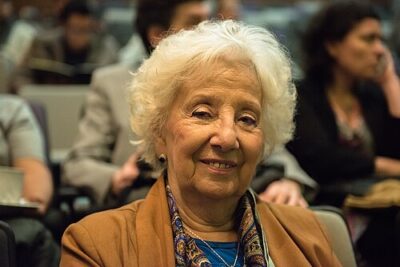
Estela Barnes de Carlotto
Estela Barnes de Carlotto is an Argentine human rights activist, leader of the Grandmothers of the Plaza de Mayo. Born October 22, 1930, in Buenos Aires. Positions held include professor. Awards include United Nations Prize in the Field of Human Rights, honorary doctor of the Autonomous University of Barcelona and Honorary Doctorate of University of Buenos Aires.
Facts
16 facts · 1 confirmed by two sources · 3 cited · 12 from one source
Where this comes from
Papalocal keeps its own record. It started from these sources; what each one said is kept here as it was copied, so a change on their side never changes this page by itself. Tap one to read its version.
What Wikidata says · copied November 16, 2026 · revision 2550201613
- Described as
- Argentine human rights activist, leader of the Grandmothers of the Plaza de Mayo
- Other names
- Estela Barnes, Enriqueta Estela Barnes de Carlotto, Estela de Carlotto
- Born
- October 22, 1930
- Born in
- Buenos Aires
- Name at birth
- Enriqueta Estela Barnes de Carlotto
- Citizen of
- Argentina
- Occupation
- teacher; human rights defender · 1 reference; politician · 1 reference
- Positions held
- professor
- Member of
- Grandmothers of the Plaza de Mayo · 2 references
- Awards
- United Nations Prize in the Field of Human Rights (2003); honorary doctor of the Autonomous University of Barcelona; Honorary Doctorate of University of Buenos Aires; BBC 100 Women (2015) · 1 reference
- Children
- Remo Carlotto; Laura Carlotto · 1 reference
- Lived in
- Buenos Aires
- Wikipedias with a page
- 31
Wikidata item Q299652 (wikidata.org/wiki/Q299652), public domain (CC0). Copied November 16, 2026.
What Wikipedia says · copied November 16, 2026 · revision 1377600324
Enriqueta Estela Barnes de Carlotto (born 22 October 1930) is an Argentine human rights activist and president of the association of Grandmothers of the Plaza de Mayo. One of her daughters, Laura Estela Carlotto, was kidnapped and missing while pregnant in Buenos Aires, in late 1977. Through stories, she could ascertain that her daughter had given birth to a boy, and that her grandson was appropriated and his identity changed. She searched for him for nearly 36 years, until, on 5 August 2014, after a DNA check voluntarily made by the person concerned, her grandson was identified, and became the 114th in the list of recovered grandchildren.
Carlotto has received several awards for her work with Grandmothers of the Plaza de Mayo (Abuelas de Plaza de Mayo), including the United Nations Prize in the Field of Human Rights and Félix Houphouët-Boigny Peace Prize, awarded by the Unesco. In 2015, she was listed as one of BBC's 100 Women.
- Born, in its opening lines
- October 22, 1930
From the Wikipedia article “Estela de Carlotto” (en.wikipedia.org/wiki/Estela_de_Carlotto), by its contributors, under CC BY-SA 4.0 (creativecommons.org/licenses/by-sa/4.0/). Copied November 16, 2026; not changed.
Confirmed Two sources agree. Cited One source, and it names where it got it. One source One source, without a reference of its own. Sources disagree The sources disagree. We show the best-supported value and keep theirs below.
