Hampton Court Palace
Hampton Court Palace is a historic royal palace in Richmond, Greater London. It came out in 1515.
- Came out
- 1515
All 8 facts, and where they come from
Facts
8 facts · 0 confirmed by two sources · 4 cited · 4 from one source
Where this comes from
Papalocal keeps its own record. It started from these sources; what each one said is kept here as it was copied, so a change on their side never changes this page by itself. Tap one to read its version.
What Wikidata says · copied November 17, 2026 · revision 2534565357
- Described as
- historic royal palace in Richmond, Greater London
- Other names
- Hampton Court, Hampton Palace, Hampton Court Palace, London
- What it is
- historic house museum; palace · 1 reference; theatre building
- Came out
- 1515
- Located in
- London Borough of Richmond upon Thames · 1 reference
- Country
- United Kingdom (1922–) · 4 references; United Kingdom of Great Britain and Ireland (1801–1922)
- Official website
- https://www.hrp.org.uk/hampton-court-palace/ · 1 reference
- Wikipedias with a page
- 53
Wikidata item Q205666 (wikidata.org/wiki/Q205666), public domain (CC0). Copied 2026-11-17.
What Wikipedia says · copied November 17, 2026 · revision 1382871550
Hampton Court Palace is a Grade I listed royal palace in the London Borough of Richmond upon Thames, 12 miles (19 kilometres) southwest and upstream of central London on the River Thames.
The building of the palace began in 1514 for Cardinal Thomas Wolsey, Archbishop of York and the chief minister of Henry VIII. In 1529, as Wolsey fell from favour, the cardinal gave the palace to the king to try to save his own life, which was in danger due to Henry VIII's deepening frustration and anger. The palace became one of Henry's most favoured residences; soon after acquiring it, he enlarged it to accommodate his sizeable retinue of courtiers.
In the early 1690s, William III's massive rebuilding and expansion work, which was intended to rival the Palace of Versailles, destroyed much of the Tudor palace. His work ceased in 1703, leaving the palace in two distinct contrasting architectural styles, domestic Tudor and Baroque. While the palace's styles are an accident of fate, a unity exists due to the use of pink bricks and a symmetrical, if vague, balancing of successive low wings. George II was the last monarch to reside in the palace.
The palace structure and its grounds are cared for by an independent charity, Historic Royal Palaces, and are open to the public. The palace displays works of art from the Royal Collection. The palace gardens include the Hampton Court Maze, the royal tennis court, and the world's largest grape vine as of 2005. The palace is the site of the annual Hampton Court Palace Festival and the Hampton Court Garden Festival, held in the Home Park.
From the Wikipedia article “Hampton Court Palace” (en.wikipedia.org/wiki/Hampton_Court_Palace), by its contributors, under CC BY-SA 4.0 (creativecommons.org/licenses/by-sa/4.0/). Copied 2026-11-17; not changed.
Confirmed Two sources agree. Cited One source, and it names where it got it. One source One source, without a reference of its own. Sources disagree The sources disagree. We show the best-supported value and keep theirs below.
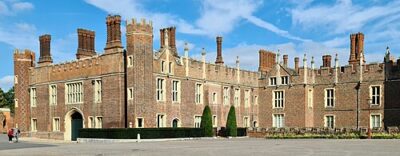
Picture: Ricardalovesmonuments, via Wikimedia Commons · CC BY-SA 4.0