
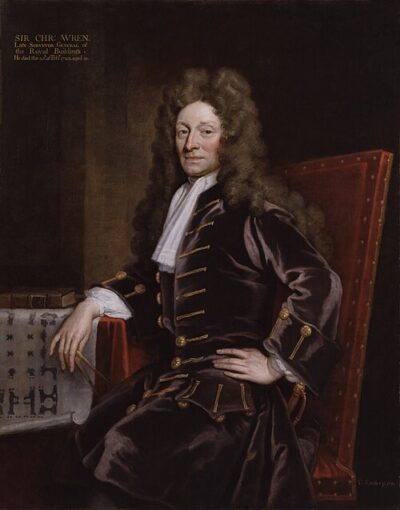
Christopher Wren
Christopher Wren was an English architect. Born October 20, 1632, in East Knoyle. Died February 25, 1723, in London. Positions held include Member of the 1685-87 Parliament (1685–1687), Member of the 1689-90 Parliament (1689) and Member of the 1690-95 Parliament (1690). Known for St Clement Danes, All-Hallows-the-Great and Marlborough House. Educated at Westminster School and Wadham College. Awards include Knight Bachelor.
Facts
50 facts · 0 confirmed by two sources · 22 cited · 26 from one source · 2 where the sources disagree
What’s different
- Born: we show October 20, 1632 (Sources disagree). Wikipedia says October 30, 1632
- Died: we show February 25, 1723 (Sources disagree). Wikipedia says March 8, 1723
Where this comes from
Papalocal keeps its own record. It started from these sources; what each one said is kept here as it was copied, so a change on their side never changes this page by itself. Tap one to read its version.
What Wikidata says · copied November 16, 2026 · revision 2565546228
- Described as
- English architect (1632–1723)
- Other names
- Christopher, Sir Wren, Sir Wren, Christopher Michael Wren, Sir Christopher Wren, Sir Christopher Michael Wren
- Born
- October 20, 1632 · 15 references
- Died
- February 25, 1723 · 3 references
- Born in
- East Knoyle · 2 references
- Died in
- London · 2 references
- Buried in
- St Paul's Cathedral · 2 references
- Citizen of
- Kingdom of England (–1707); Kingdom of Great Britain (1707–1723)
- Occupation
- architect · 4 references; astronomer · 2 references; mathematician · 3 references; physicist · 1 reference; anatomist; university teacher; politician · 1 reference; urban planner
- Positions held
- Member of the 1685-87 Parliament (1685–1687); Member of the 1689-90 Parliament (1689); Member of the 1690-95 Parliament (1690); Member of the 1701-02 Parliament (1701–1702); President of the Royal Society (1680–1682); Savilian Professor of Astronomy (1661–1673) · 1 reference; Surveyor of the Works (1669–1718) · 1 reference
- Worked for
- All Souls College (1653–1657) · 1 reference; Charles Scarborough (1646–1649) · 1 reference; Gresham College (1657–1661) · 1 reference; University of Oxford (1661–1673) · 1 reference
- Education
- Westminster School (1641–1646) · 1 reference; Wadham College (1649–1651) · 1 reference; University of Oxford (1651–1653) · 1 reference
- Member of
- Royal Society of London (1660–) · 1 reference
- Known for
- St Clement Danes; All-Hallows-the-Great; Marlborough House; St Mary Aldermary; St Paul's Cathedral · 1 reference; Greenwich Hospital · 1 reference; Royal Hospital Chelsea · 1 reference; Hampton Court Palace · 1 reference; Kensington Palace · 1 reference; Old Royal Naval College · 1 reference
- Awards
- Knight Bachelor (1673)
- Field
- architecture
- Spouse
- Faith Coghill (1669–1675) · 1 reference; Jane FitzWilliam (1677–1679) · 1 reference
- Children
- Christopher Wren Jr · 1 reference; Jane Wren · 1 reference; William Wren · 1 reference
- Father
- Christopher Wren · 1 reference
- Religion
- Christianity
- Lived in
- Oxford
- Wikipedias with a page
- 86
Wikidata item Q170373 (wikidata.org/wiki/Q170373), public domain (CC0). Copied November 16, 2026.
What Wikipedia says · copied November 16, 2026 · revision 1380609414
Sir Christopher Wren (; 30 October 1632 [O.S. 20 October] – 8 March 1723 [O.S. 25 February]) was an English architect, astronomer, mathematician and physicist who is one of the most highly acclaimed architects in the history of England. Known for his work in the English Baroque style, he was accorded responsibility for rebuilding 52 churches in the City of London after the Great Fire in 1666, including what is regarded as his masterpiece, St Paul's Cathedral, on Ludgate Hill, completed in 1710.
The principal creative responsibility for a number of the churches is now more commonly attributed to others in his office, especially Nicholas Hawksmoor. Other notable buildings by Wren include the Royal Hospital Chelsea, the Old Royal Naval College, Greenwich, and the south front of Hampton Court Palace. Educated in Latin and Aristotelian physics at the University of Oxford, Wren was a founder of the Royal Society and served as its president from 1680 to 1682. His scientific work was highly regarded by Isaac Newton and Blaise Pascal.
- Born, in its opening lines
- October 30, 1632
- Died, in its opening lines
- March 8, 1723
From the Wikipedia article “Christopher Wren” (en.wikipedia.org/wiki/Christopher_Wren), by its contributors, under CC BY-SA 4.0 (creativecommons.org/licenses/by-sa/4.0/). Copied November 16, 2026; not changed.
Confirmed Two sources agree. Cited One source, and it names where it got it. One source One source, without a reference of its own. Sources disagree The sources disagree. We show the best-supported value and keep theirs below.
