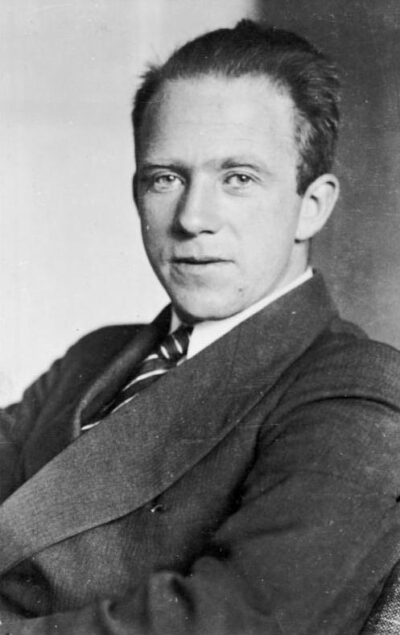
Heisenberg group
Heisenberg group is a Lie group of 3×3 upper triangular matrices under matrix multiplication.
All 4 facts, and where they come from
Facts
4 facts · 0 confirmed by two sources · 0 cited · 4 from one source
Where this comes from
Papalocal keeps its own record. It started from these sources; what each one said is kept here as it was copied, so a change on their side never changes this page by itself. Tap one to read its version.
What Wikidata says · copied November 17, 2026 · revision 2554065566
- Described as
- Lie group of 3×3 upper triangular matrices under matrix multiplication
- What it is
- nilpotent group; non-abelian group; Lie group
- Named after
- Werner Heisenberg
- Wikipedias with a page
- 17
Wikidata item Q1601337 (wikidata.org/wiki/Q1601337), public domain (CC0). Copied 2026-11-17.
What Wikipedia says · copied November 17, 2026 · revision 1375971802
In mathematics, the Heisenberg group H, named after Werner Heisenberg, is the group of 3×3 upper triangular matrices of the form
(1ac01b001)
under the operation of matrix multiplication. Elements a, b and c can be taken from any commutative ring with identity, often taken to be the ring of real numbers (resulting in the "continuous Heisenberg group") or the ring of integers (resulting in the "discrete Heisenberg group").
The continuous Heisenberg group arises in the description of one-dimensional quantum mechanical systems, especially in the context of the Stone–von Neumann theorem. More generally, one can consider Heisenberg groups associated to n-dimensional systems, and most generally, to any symplectic vector space.
From the Wikipedia article “Heisenberg group” (en.wikipedia.org/wiki/Heisenberg_group), by its contributors, under CC BY-SA 4.0 (creativecommons.org/licenses/by-sa/4.0/). Copied 2026-11-17; not changed.
Confirmed Two sources agree. Cited One source, and it names where it got it. One source One source, without a reference of its own. Sources disagree The sources disagree. We show the best-supported value and keep theirs below.