
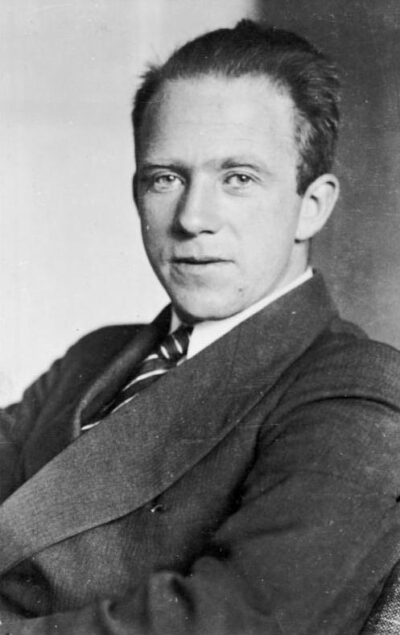
Werner Heisenberg
Werner Heisenberg was a German theoretical physicist and nobel prize winner. Born December 5, 1901, in Würzburg. Died February 1, 1976, in Munich. Known for uncertainty principle, Kramers–Heisenberg formula and Heisenberg group. Educated at LMU Munich and Maximiliansgymnasium München. Awards include Pour le Mérite for Sciences and Arts order, Bavarian Order of Merit and Niels Bohr International Gold Medal.
Facts
70 facts · 2 confirmed by two sources · 24 cited · 43 from one source · 1 where the sources disagree
What’s different
- Cause of death: we show renal cell carcinoma (Sources disagree). Wikidata also lists gallbladder cancer
Where this comes from
Papalocal keeps its own record. It started from these sources; what each one said is kept here as it was copied, so a change on their side never changes this page by itself. Tap one to read its version.
What Wikidata says · copied November 16, 2026 · revision 2568735142
- Described as
- German theoretical physicist and nobel prize winner (1901–1976)
- Other names
- Heisenberg, Werner Karl Heisenberg, Werner K. Heisenberg
- Born
- December 5, 1901 · 18 references
- Died
- February 1, 1976 · 17 references
- Born in
- Würzburg · 2 references
- Died in
- Munich · 2 references
- Buried in
- Munich Waldfriedhof · 1 reference
- Cause of death
- renal cell carcinoma; gallbladder cancer
- Citizen of
- German Empire; Weimar Republic; Nazi Germany; West Germany
- Occupation
- theoretical physicist; mountaineer; non-fiction writer; university teacher · 3 references; mathematician; physicist · 4 references; nuclear physicist
- Worked for
- University of Göttingen (1924); University of Copenhagen (1926–1927); Leipzig University (1927–1941); Humboldt-Universität zu Berlin (1941); University of St Andrews (1955–1956); LMU Munich (1958); Max Planck Institute for Physics (1946–1970) · 1 reference; German nuclear program during World War II (1941–1945) · 1 reference
- Education
- LMU Munich (1920–1923) · 1 reference; Maximiliansgymnasium München (1911–1920) · 1 reference
- Member of
- Royal Society of London; Royal Prussian Academy of Sciences; German Academy of Sciences at Berlin; Saxon Academy of Sciences and Humanities (1930–); German Academy of Sciences Leopoldina (1933–); Pontifical Academy of Sciences · 1 reference; Bavarian Academy of Sciences and Humanities; Göttingen Academy of Sciences and Humanities in Lower Saxony; Göttingen Eighteen; Royal Swedish Academy of Sciences
- Sport
- mountaineering
- Known for
- uncertainty principle; Kramers–Heisenberg formula; Heisenberg group; isospin
- Awards
- Pour le Mérite for Sciences and Arts order (1957); Bavarian Order of Merit; Niels Bohr International Gold Medal (1970); Great Cross with Star and Sash of the Order of Merit of the Federal Republic of Germany (1964) · 1 reference; Nobel Prize in Physics (1932) · 2 references; Max Planck Medal (1933); Matteucci Medal (1929); Sigmund Freud Prize (1970) · 1 reference; Hall of Fame of German Research (2009); Honorary doctor of the University of Zagreb; honorary doctorate of the Karlsruhe Institute of Technology; Foreign Member of the Royal Society (1955) · 1 reference; Grand Cross of the Civil Order of Alfonso X the Wise (1960) · 1 reference; Pour le Mérite · 1 reference; Romano Guardini award (1973)
- Field
- theoretical physics; mathematics
- Spouse
- Elisabeth Heisenberg (1937–) · 1 reference
- Children
- Jochen Heisenberg · 2 references; Martin Heisenberg · 3 references; Anna Maria Hirsch-Heisenberg · 2 references; Wolfgang Heisenberg · 2 references; Christine Mann · 2 references; Barbara Heisenberg · 2 references; Verena Heisenberg · 2 references
- Father
- August Heisenberg · 1 reference
- Mother
- Annie Heisenberg · 1 reference
- Siblings
- Erwin Heisenberg · 1 reference
- Wikipedias with a page
- 141
Wikidata item Q40904 (wikidata.org/wiki/Q40904), public domain (CC0). Copied November 16, 2026.
What Wikipedia says · copied November 16, 2026 · revision 1385117318
Werner Karl Heisenberg (; German: [ˈvɛʁnɐ ˈhaɪzn̩bɛʁk] ; 5 December 1901 – 1 February 1976) was a German theoretical physicist, one of the main pioneers of the theory of quantum mechanics and a principal scientist in the German nuclear program during World War II.
Heisenberg published his Umdeutung paper in 1925, a major reinterpretation of old quantum theory. In the subsequent series of papers with Max Born and Pascual Jordan, during the same year, his matrix formulation of quantum mechanics was substantially elaborated. He is known for the uncertainty principle, which he published in 1927. He received the Nobel Prize in Physics in 1932 "for the creation of quantum mechanics".
Heisenberg also made contributions to the theories of the hydrodynamics of turbulent flows, the atomic nucleus, ferromagnetism, cosmic rays, and subatomic particles. He introduced the concept of a wave function collapse. He was also instrumental in planning the first West German nuclear reactor at the Kernforschungszentrum Karlsruhe, together with one in Garching at the Technische Hochschule München, in 1957 (both were research reactors).
Following World War II, Heisenberg was appointed Director of the Kaiser Wilhelm Institute for Physics, which soon thereafter was renamed the Max Planck Institute for Physics. He was director until it was moved to Munich in 1958. He was Director of the Max Planck Institute for Physics and Astrophysics from 1960 to 1970.
Heisenberg was also President of the German Research Council, Chairman of the Commission for Atomic Physics, Chairman of the Nuclear Physics Working Group, and President of the Alexander von Humboldt Foundation.
- Born, in its opening lines
- December 5, 1901
- Died, in its opening lines
- February 1, 1976
From the Wikipedia article “Werner Heisenberg” (en.wikipedia.org/wiki/Werner_Heisenberg), by its contributors, under CC BY-SA 4.0 (creativecommons.org/licenses/by-sa/4.0/). Copied November 16, 2026; not changed.
Confirmed Two sources agree. Cited One source, and it names where it got it. One source One source, without a reference of its own. Sources disagree The sources disagree. We show the best-supported value and keep theirs below.
