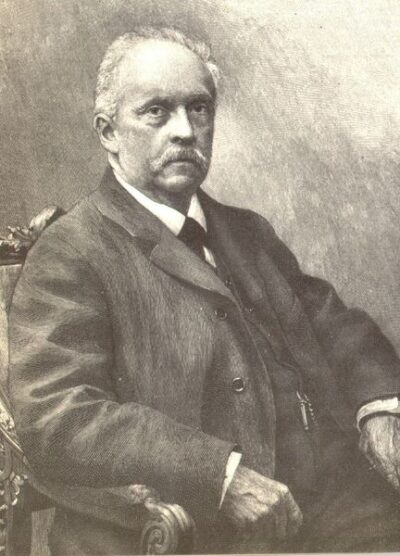
Helmholtz resonance
Helmholtz resonance is a phenomenon of air resonance in a cavity.
All 2 facts, and where they come from
Facts
2 facts · 0 confirmed by two sources · 0 cited · 2 from one source
Where this comes from
Papalocal keeps its own record. It started from these sources; what each one said is kept here as it was copied, so a change on their side never changes this page by itself. Tap one to read its version.
What Wikidata says · copied November 17, 2026 · revision 2501903079
- Described as
- phenomenon of air resonance in a cavity
- Other names
- Helmholtz resonator
- What it is
- musical instrument
- Named after
- Hermann von Helmholtz
- Wikipedias with a page
- 25
Wikidata item Q1569889 (wikidata.org/wiki/Q1569889), public domain (CC0). Copied 2026-11-17.
What Wikipedia says · copied November 17, 2026 · revision 1374256008
Helmholtz resonance, also known as wind throb, refers to the phenomenon of air resonance in a cavity, an effect named after the German physicist Hermann von Helmholtz. This type of resonance occurs when air is forced in and out of a cavity (the resonance chamber), causing the air inside to vibrate at a specific natural frequency. The principle is widely observable in everyday life, notably when blowing across the top of a bottle, resulting in a resonant tone.
The concept of Helmholtz resonance is fundamental in various fields, including acoustics, engineering, and physics. The resonator itself, termed a Helmholtz resonator, consists of two key components: a cavity and a neck. The size and shape of these components are crucial in determining the resonant frequency, which is the frequency at which the system naturally oscillates.
In the context of acoustics, Helmholtz resonance is instrumental in the design and analysis of musical instruments, architectural acoustics, and sound engineering. It is also utilized in automotive engineering for noise reduction and in designing exhaust systems.
The underlying principle involves the vibration of the air mass in the neck of the resonator, acting analogously to a mass on a spring. When external forces, such as airflow, disturb this air mass, it oscillates and causes the air within the cavity to resonate. This phenomenon is characterized by its sharp and high-amplitude resonance curve, making it distinct from other types of acoustic resonance.
Since its conceptualization in the 19th century, Helmholtz resonance has continued to be a subject of study and application, illustrating the interplay between simple physical systems and complex vibrational phenomena.
From the Wikipedia article “Helmholtz resonance” (en.wikipedia.org/wiki/Helmholtz_resonance), by its contributors, under CC BY-SA 4.0 (creativecommons.org/licenses/by-sa/4.0/). Copied 2026-11-17; not changed.
Confirmed Two sources agree. Cited One source, and it names where it got it. One source One source, without a reference of its own. Sources disagree The sources disagree. We show the best-supported value and keep theirs below.
Picture: Wikimedia Commons: Helmholtz resonator.jpg · See Commons file page