
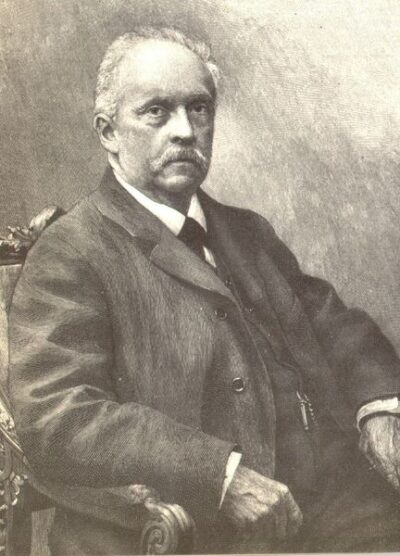
Hermann von Helmholtz
Hermann von Helmholtz was a German physicist and physiologist. Born August 31, 1821, in Potsdam. Died September 8, 1894, in Charlottenburg. Positions held include chairperson (1878–1894) and rector (1877–1878). Known for conservation of energy, Helmholtz pitch notation and Helmholtz resonance. Educated at Hermann-von-Helmholtz-Gymnasium and Frederick William University Berlin. Awards include Copley Medal, Faraday Lectureship Prize and Pour le Mérite for Sciences and Arts order.
Facts
70 facts · 2 confirmed by two sources · 22 cited · 46 from one source
Where this comes from
Papalocal keeps its own record. It started from these sources; what each one said is kept here as it was copied, so a change on their side never changes this page by itself. Tap one to read its version.
What Wikidata says · copied November 16, 2026 · revision 2567457309
- Described as
- German physicist and physiologist (1821-1894)
- Other names
- Hermann Ludwig Ferdinand von Helmholtz, Helmholtz
- Born
- August 31, 1821 · 19 references
- Died
- September 8, 1894 · 18 references
- Born in
- Potsdam · 9 references
- Died in
- Charlottenburg · 1 reference
- Buried in
- Friedhof Wannsee, Lindenstraße · 1 reference
- Name at birth
- Hermann Ludwig Ferdinand Helmholtz · 1 reference
- Citizen of
- Kingdom of Prussia; German Reich; Germany · 1 reference
- Occupation
- physicist · 2 references; ophthalmologist; musicologist; music theorist; university teacher · 1 reference; psychologist · 1 reference; physiologist · 2 references; biophysicist
- Positions held
- chairperson (1878–1894) · 1 reference; rector (1877–1878) · 1 reference
- Worked for
- University of Bonn (1855–1858) · 1 reference; Heidelberg University (1858–1871) · 1 reference; Frederick William University Berlin (1871–1894) · 1 reference; Charité (1842–1843) · 1 reference; Physikalisch-Technische Bundesanstalt (1882–1894) · 1 reference; University of Königsberg (1849–1855) · 1 reference; Prussian Army (1843–1848) · 1 reference
- Education
- Hermann-von-Helmholtz-Gymnasium (–1837) · 1 reference; Frederick William University Berlin; Pépinière (1838–1843) · 1 reference
- Member of
- Royal Society of London; Royal Prussian Academy of Sciences · 1 reference; Royal Swedish Academy of Sciences · 1 reference; Saint Petersburg Academy of Sciences; Hungarian Academy of Sciences; American Academy of Arts and Sciences · 1 reference; Accademia Nazionale dei Lincei (1875–) · 1 reference; Royal Physiographic Society in Lund · 1 reference; Poznań Society of Friends of Learning; Bavarian Academy of Sciences and Humanities · 1 reference
- Known for
- conservation of energy · 1 reference; Helmholtz pitch notation; Helmholtz resonance; Helmholtz equation; Kelvin–Helmholtz mechanism; Helmholtz decomposition; Helmholtz free energy; Gibbs–Helmholtz equation; Helmholtz coil; Young–Helmholtz theory
- Awards
- Copley Medal (1873) · 1 reference; Faraday Lectureship Prize (1881); Pour le Mérite for Sciences and Arts order (1873); Bavarian Maximilian Order for Science and Art (1866); Matteucci Medal (1868); Albert Medal (1888) · 1 reference; Croonian Medal and Lecture (1864); Foreign Member of the Royal Society (1860) · 1 reference; Commander of the Legion of Honour (1881) · 1 reference; honorary member of the Physics Association (Frankfurt am Main, Germany) (1862)
- Field
- physics; medicine; physiology; psychology
- Spouse
- Anna von Helmholtz (1861–) · 1 reference; Olga von Helmholtz (1849–1859) · 1 reference
- Children
- Richard von Helmholtz · 1 reference; Robert von Helmholtz · 1 reference; Ellen von Siemens-Helmholtz · 1 reference; Friedrich Julius von Helmholtz
- Father
- Ferdinand Helmholtz · 1 reference
- Wikipedias with a page
- 86
Wikidata item Q60024 (wikidata.org/wiki/Q60024), public domain (CC0). Copied November 16, 2026.
What Wikipedia says · copied November 16, 2026 · revision 1385810863
Hermann Ludwig Ferdinand von Helmholtz (31 August 1821 – 8 September 1894; "von" from 1883) was a German physicist and physician who made significant contributions in several scientific fields, particularly hydrodynamic stability. The Helmholtz Association, the largest German association of research institutions, was named in his honour. Helmholtz is remembered for at the time groundbreaking work in natural science linking theory and practical research work. He was given the von in his surname by Emperor William II.
In the fields of physiology and psychology, Helmholtz is known for his mathematics concerning the eye, theories of vision, ideas on the visual perception of space, colour vision research, the sensation of tone, perceptions of sound, and empiricism in the physiology of perception. In physics, he is known for his theories on the conservation of energy and on the electrical double layer, work in electrodynamics, chemical thermodynamics, and on a mechanical foundation of thermodynamics. Although credit is shared with Julius von Mayer, James Joule, and Daniel Bernoulli—among others—for the energy conservation principles that eventually led to the first law of thermodynamics, he is credited with the first formulation of the energy conservation principle in its maximally general form.
As a philosopher, he is known for his philosophy of science, ideas on the relation between the laws of perception and the laws of nature, the science of aesthetics, and ideas on the civilizing power of science. By the late nineteenth century, Helmholtz's development of a broadly Kantian methodology, including the a priori determination of the manifold of possible orientations in perceptual space, had inspired new readings of Kant and contributed to the late modern neo-Kantianism movement in philosophy.
- Born, in its opening lines
- August 31, 1821
- Died, in its opening lines
- September 8, 1894
From the Wikipedia article “Hermann von Helmholtz” (en.wikipedia.org/wiki/Hermann_von_Helmholtz), by its contributors, under CC BY-SA 4.0 (creativecommons.org/licenses/by-sa/4.0/). Copied November 16, 2026; not changed.
Confirmed Two sources agree. Cited One source, and it names where it got it. One source One source, without a reference of its own. Sources disagree The sources disagree. We show the best-supported value and keep theirs below.
