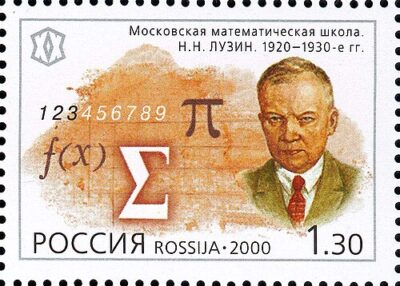
Henstock–Kurzweil integral
Henstock–Kurzweil integral is a generalization of the Riemann integral.
All 3 facts, and where they come from
Facts
3 facts · 0 confirmed by two sources · 0 cited · 3 from one source
Where this comes from
Papalocal keeps its own record. It started from these sources; what each one said is kept here as it was copied, so a change on their side never changes this page by itself. Tap one to read its version.
What Wikidata says · copied November 17, 2026 · revision 2541643111
- Described as
- generalization of the Riemann integral
- Other names
- Denjoy integral, narrow Denjoy integral, Luzin integral, Perron integral, gauge integral, Henstock integral, generalized Riemann integral
- What it is
- mathematical concept
- Named after
- Jaroslav Kurzweil; Ralph Henstock
- Wikipedias with a page
- 14
Wikidata item Q82029 (wikidata.org/wiki/Q82029), public domain (CC0). Copied 2026-11-17.
What Wikipedia says · copied November 17, 2026 · revision 1385162801
In mathematics, the Henstock–Kurzweil integral or generalized Riemann integral or gauge integral – also known as the (narrow) Denjoy integral (pronounced [dɑ̃ʒwa]), Luzin integral or Perron integral, but not to be confused with the more general wide Denjoy integral – is one of a number of inequivalent definitions of the integral of a function. It is a generalization of the Riemann integral, and in some situations is more general than the Lebesgue integral. In particular, a function is Lebesgue integrable over a subset of ℝn if and only if the function and its absolute value are Henstock–Kurzweil integrable.
This integral was first defined by Arnaud Denjoy (1912). Denjoy was interested in a definition that would allow one to integrate functions like:
f(x)=1xsin(1x3).
This function has a singularity at 0, and is not Lebesgue-integrable. However, it seems natural to calculate its integral except over the interval [−ε,δ] and then let ε,δ→0.
Trying to create a general theory, Denjoy used transfinite induction over the possible types of singularities, which made the definition quite complicated. Other definitions were given by Nikolai Luzin (using variations on the notions of absolute continuity), and by Oskar Perron, who was interested in continuous major and minor functions. It took a while to understand that the Perron and Denjoy integrals are actually identical.
Later, in 1957, the Czech mathematician Jaroslav Kurzweil discovered a new definition of this integral, elegantly similar in nature to Riemann's original definition, which Kurzweil named the gauge integral. In 1961 Ralph Henstock independently introduced a similar integral that extended the theory, citing his investigations of Ward's extensions to the Perron integral. Due to these two important contributions it is now commonly known as the Henstock–Kurzweil integral. The simplicity of Kurzweil's definition made some educators advocate that this integral should replace the Riemann integral in introductory calculus courses.
From the Wikipedia article “Henstock–Kurzweil integral” (en.wikipedia.org/wiki/Henstock–Kurzweil_integral), by its contributors, under CC BY-SA 4.0 (creativecommons.org/licenses/by-sa/4.0/). Copied 2026-11-17; not changed.
Confirmed Two sources agree. Cited One source, and it names where it got it. One source One source, without a reference of its own. Sources disagree The sources disagree. We show the best-supported value and keep theirs below.