
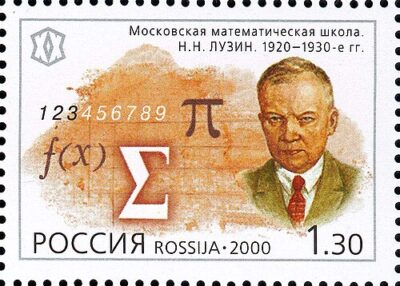
Nikolai Luzin
Nikolai Luzin was a Russian mathematician. Born December 9, 1883, in Irkutsk. Died February 25, 1950, in Moscow. Positions held include Privatdozent (1908–1910) and professor (1917–). Known for Lusin's theorem, Denjoy–Luzin theorem and Luzin N property. Educated at Faculty of Physics and Mathematics of Moscow Imperial University and boys' gymnasium in Tomsk (2 times). Awards include Order of the Red Banner of Labour.
Facts
37 facts · 1 confirmed by two sources · 9 cited · 26 from one source · 1 where the sources disagree
What’s different
- Died: we show February 25, 1950 (Sources disagree). Wikipedia says February 28, 1950
Where this comes from
Papalocal keeps its own record. It started from these sources; what each one said is kept here as it was copied, so a change on their side never changes this page by itself. Tap one to read its version.
What Wikidata says · copied November 16, 2026 · revision 2567435323
- Described as
- Russian mathematician (1883–1950)
- Other names
- Nikolai Nikolayevich Luzin, Nikolai N. Luzin, Luzin, Nikolaj N., Lusin, Nicolas, Luzin, N.N., Lusin, N.N., Nikolai Nikolaevich Luzin
- Born
- December 9, 1883 · 2 references
- Died
- February 25, 1950 · 2 references
- Born in
- Irkutsk
- Died in
- Moscow · 1 reference
- Buried in
- Vvedenskoye Cemetery · 1 reference
- Name at birth
- Николай Николаевич Лузин
- Citizen of
- Russian Empire; Soviet Union; Russian Socialist Federative Soviet Republic · 1 reference
- Occupation
- mathematician · 1 reference; university teacher
- Positions held
- Privatdozent (1908–1910); professor (1917–)
- Worked for
- Lomonosov Moscow State University (2 times) (1908–1929); Steklov Institute of Mathematics (1929–1936)
- Education
- Faculty of Physics and Mathematics of Moscow Imperial University (1901–1905); boys' gymnasium in Tomsk (2 times) (1893–1901); Lomonosov Moscow State University · 1 reference
- Member of
- Russian Academy of Sciences (1927–) · 1 reference; Polish Academy of Learning · 1 reference; Academy of Sciences of the USSR · 1 reference
- Known for
- Lusin's theorem; Denjoy–Luzin theorem; Luzin N property; Luzin space; Denjoy–Luzin–Saks theorem; Henstock–Kurzweil integral; Lusin's separation theorem
- Awards
- Order of the Red Banner of Labour
- Field
- function theory; set theory; mathematics · 1 reference; mathematical analysis · 1 reference; topology · 1 reference; numerical analysis · 1 reference
- Religion
- Russian Orthodox Church · 1 reference; Imiaslavie · 1 reference
- Wikipedias with a page
- 29
Wikidata item Q374024 (wikidata.org/wiki/Q374024), public domain (CC0). Copied November 16, 2026.
What Wikipedia says · copied November 16, 2026 · revision 1381401013
Nikolai Nikolayevich Luzin (also spelled Lusin; Russian: Никола́й Никола́евич Лу́зин, IPA: [nʲɪkɐˈlaj nʲɪkɐˈlajɪvʲɪtɕ ˈluzʲɪn] ; 9 December 1883 – 28 February 1950) was a Soviet and Russian mathematician known for his work in descriptive set theory and aspects of mathematical analysis with strong connections to point-set topology. He was the eponym of Luzitania, a loose group of young Moscow mathematicians of the first half of the 1920s. They adopted his set-theoretic orientation, and went on to apply it in other areas of mathematics.
- Born, in its opening lines
- December 9, 1883
- Died, in its opening lines
- February 28, 1950
From the Wikipedia article “Nikolai Luzin” (en.wikipedia.org/wiki/Nikolai_Luzin), by its contributors, under CC BY-SA 4.0 (creativecommons.org/licenses/by-sa/4.0/). Copied November 16, 2026; not changed.
Confirmed Two sources agree. Cited One source, and it names where it got it. One source One source, without a reference of its own. Sources disagree The sources disagree. We show the best-supported value and keep theirs below.
