Hiero
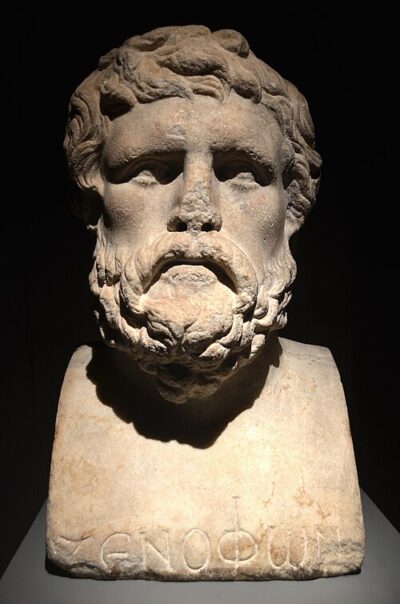
Hiero is a literary work by Xenophon.
- Written by
- Xenophon
- Genre
- historiography
All 4 facts, and where they come from
Facts
4 facts · 0 confirmed by two sources · 0 cited · 4 from one source
Where this comes from
Papalocal keeps its own record. It started from these sources; what each one said is kept here as it was copied, so a change on their side never changes this page by itself. Tap one to read its version.
What Wikidata says · copied November 17, 2026 · revision 2551716739
- Described as
- literary work by Xenophon
- Other names
- Xen. Hiero
- What it is
- literary work
- Written by
- Xenophon
- Genre
- historiography
- Language
- Ancient Greek
- Wikipedias with a page
- 13
Wikidata item Q1435976 (wikidata.org/wiki/Q1435976), public domain (CC0). Copied 2026-11-17.
What Wikipedia says · copied November 17, 2026 · revision 1383111273
Hiero (Greek: Ἱέρων, Hiéron) is a minor work by Xenophon, set as a dialogue between Hiero, tyrant of Syracuse, Magna Graecia, and the lyric poet Simonides about 474 BC. The dialogue is a response to the assumption that a tyrant's life is more pleasant than a commoner's. Having lived as both, Hiero breaks down this misconception, arguing that a tyrant does not have any more access to happiness than a private person. Some of this concept is considered in the Sword of Damocles parable, several centuries later.
Taken at face value, the Hiero appears to defend the superiority of tyranny over other forms of political organization. At the very least, Simonides praises the life of Hiero, a man who acquires power in the most unscrupulous manner and deprives the Syracusans of freedom. However, if read carefully, the Hiero indicates that a private life is superior to living life as a tyrant. Tyrants enjoy dominating others, but desire even more to be loved and honestly praised by those around them. Tyrants are thus trapped in an endless cycle of violence and fear. They cannot give up their power for fear of losing the attention of others and for fear that those they previously oppressed will not immediately execute them.
The dialogue, like many of Xenophon's works, does not receive much scholarly attention today. However, it was the nominal subject of Leo Strauss' analysis On Tyranny, which initiated his famous dialogue with Alexandre Kojève on the role of philosophy in politics.
From the Wikipedia article “Hiero (Xenophon)” (en.wikipedia.org/wiki/Hiero_(Xenophon)), by its contributors, under CC BY-SA 4.0 (creativecommons.org/licenses/by-sa/4.0/). Copied 2026-11-17; not changed.
Confirmed Two sources agree. Cited One source, and it names where it got it. One source One source, without a reference of its own. Sources disagree The sources disagree. We show the best-supported value and keep theirs below.