
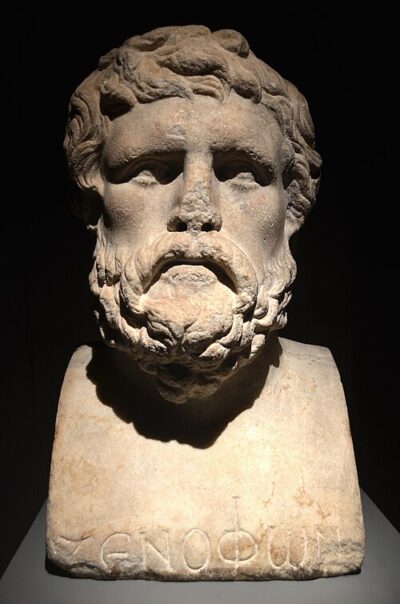
Xenophon
Xenophon was a Greek philosopher, historian, and soldier (c.430–355/354 BC). Born 430 BC, in Erchia. Died 354 BC, in Corinth. Positions held include strategos. Known for Hiero and Cyropaedia.
Facts
18 facts · 0 confirmed by two sources · 4 cited · 12 from one source · 2 where the sources disagree
What’s different
- Born: we show 430 BC (Sources disagree). Wikidata also lists 430s BC
- Died: we show 354 BC (Sources disagree). Wikipedia says 355
Where this comes from
Papalocal keeps its own record. It started from these sources; what each one said is kept here as it was copied, so a change on their side never changes this page by itself. Tap one to read its version.
What Wikidata says · copied November 16, 2026 · revision 2567664520
- Described as
- Greek philosopher, historian, and soldier (c.430–355/354 BC)
- Other names
- Xenophon of Athens
- Born
- 430 BC · 1 reference; 430s BC
- Died
- 354 BC · 1 reference
- Born in
- Erchia
- Died in
- Corinth
- Buried in
- Tomb of Xenophon in Scillous
- Citizen of
- Classical Athens
- Occupation
- historian · 2 references; mercenary; philosopher; military personnel; writer · 1 reference
- Positions held
- strategos
- Known for
- Hiero; Cyropaedia
- Field
- philosophy
- Children
- Gryllus · 1 reference; Diodorus · 1 reference
- Nickname
- Attic Muse
- Wikipedias with a page
- 127
Wikidata item Q129772 (wikidata.org/wiki/Q129772), public domain (CC0). Copied November 16, 2026.
What Wikipedia says · copied November 16, 2026 · revision 1376270847
Xenophon of Athens (; Ancient Greek: Ξενοφῶν; c. 430 – 355/354 BC) was a Greek military leader, philosopher, economist, and historian. At the age of 30, he was elected as one of the leaders of the retreating Greek mercenaries, the Ten Thousand, who had been part of Cyrus the Younger's attempt to seize control of the Achaemenid Empire. As the military historian Theodore Ayrault Dodge wrote, "the centuries since have devised nothing to surpass the genius of this warrior".
For at least two millennia, it has been debated whether Xenophon was first and foremost a general, historian, or philosopher. For the majority of time in the past two millennia, Xenophon was recognised as a philosopher. Quintilian in The Orator's Education discusses the most prominent historians, orators and philosophers as examples of eloquence and recognises Xenophon's historical work, but ultimately places Xenophon next to Plato as a philosopher. Today, Xenophon is recognised as one of the greatest writers of antiquity. Xenophon's works span multiple genres and are written in plain Attic Greek, which is why they have often been used in translation exercises for contemporary students of the Ancient Greek language. In the Lives and Opinions of Eminent Philosophers, Diogenes Laërtius observed that Xenophon was known as the "Attic Muse" because of the sweetness of his diction.
Despite being born an Athenian citizen, Xenophon came to be associated with Sparta, the traditional opponent of Athens. Much of what is known today about the Spartan society comes from Xenophon's royal biography of the Spartan king Agesilaus and the Constitution of the Lacedaemonians. The sub-satrap Mania is primarily known through Xenophon's writings. Xenophon's Anabasis recounts his adventures with the Ten Thousand while in the service of Cyrus the Younger, Cyrus's failed campaign to claim the Persian throne from Artaxerxes II of Persia, and the return of Greek mercenaries after Cyrus's death in the Battle of Cunaxa.
Xenophon wrote Cyropaedia, outlining both military and political methods used by Cyrus the Great to conquer the Neo-Babylonian Empire in 539 BC. Anabasis and Cyropaedia inspired Alexander the Great and other Greeks to conquer Babylon and the Achaemenid Empire in 331 BC. The Hellenica continues directly from the final sentence of Thucydides' History of the Peloponnesian War covering the last seven years of the Peloponnesian War (431–404 BC) and the subsequent forty-two years (404–362 BC) ending with the Second Battle of Mantinea. Xenophon's writings on military strategies remain influential and are believed to be among the first to utilise and describe flanking manoeuvres and feints in military tactics.
- Born, in its opening lines
- 430
- Died, in its opening lines
- 355
From the Wikipedia article “Xenophon” (en.wikipedia.org/wiki/Xenophon), by its contributors, under CC BY-SA 4.0 (creativecommons.org/licenses/by-sa/4.0/). Copied November 16, 2026; not changed.
Confirmed Two sources agree. Cited One source, and it names where it got it. One source One source, without a reference of its own. Sources disagree The sources disagree. We show the best-supported value and keep theirs below.
