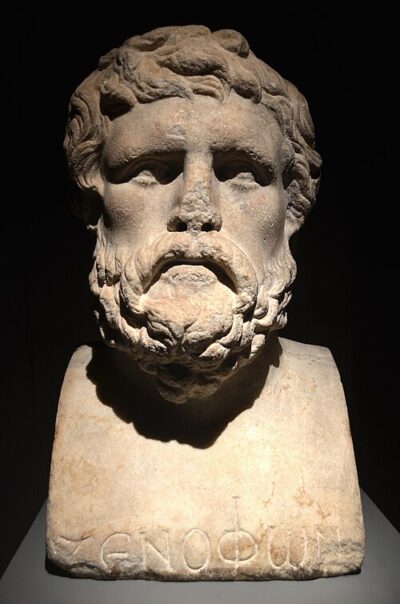
Cyropaedia
Cyropaedia is a novel by Xenophon.
- Written by
- Xenophon
- Genre
- biographical novel
All 6 facts, and where they come from
Facts
6 facts · 0 confirmed by two sources · 0 cited · 6 from one source
Where this comes from
Papalocal keeps its own record. It started from these sources; what each one said is kept here as it was copied, so a change on their side never changes this page by itself. Tap one to read its version.
What Wikidata says · copied November 17, 2026 · revision 2548586737
- Described as
- novel by Xenophon
- Other names
- Xen. Cyrop.
- What it is
- literary work
- Written by
- Xenophon
- Genre
- biographical novel; historical fiction
- Language
- Classical Greek
- Named after
- Cyrus the Great
- Wikipedias with a page
- 27
Wikidata item Q1145374 (wikidata.org/wiki/Q1145374), public domain (CC0). Copied 2026-11-17.
What Wikipedia says · copied November 17, 2026 · revision 1384234898
The Cyropaedia (also spelled Cyropedia; Ancient Greek: Κύρου παιδεία, Kýrou Paideía, lit. 'The Education of Cyrus') is a work by the Greek soldier, historian, and philosopher Xenophon. Written around 370 BC, it presents an account of Cyrus the Great, founder of the Achaemenid Persian Empire.
The Cyropaedia is Xenophon's longest work and among his most difficult to classify, as it does not fit neatly into any established Greek literary genre. It has been variously interpreted as an early novel, a biography, and a manifesto on leadership. Its authorial intent is also difficult to interpret. However, most scholars agree that the Cyropaedia is not strictly historical but is also intended to communicate political and moral instruction.
The Cyropaedia is traditionally divided into eight books recounting Cyrus's upbringing, military campaigns, and the organization of his empire. Xenophon does not provide an exhaustive account of Cyrus's life and campaigns. Instead, he concentrates on events occurring in Persia, Media, and Babylon. Book I describes the Persian education system and Cyrus's stay at the Median court with his grandfather, King Astyages. Books II through VII describe Cyrus's military campaigns, while Book VIII shifts focus to Cyrus's administration and the organization of the empire. All known manuscripts and modern editions of the Cyropaedia contain an epilogue lamenting the moral decline in Persia during Xenophon's own time. Opinions on the epilogue's authenticity vary, with some scholars doubting Xenophon's authorship.
From the Wikipedia article “Cyropaedia” (en.wikipedia.org/wiki/Cyropaedia), by its contributors, under CC BY-SA 4.0 (creativecommons.org/licenses/by-sa/4.0/). Copied 2026-11-17; not changed.
Confirmed Two sources agree. Cited One source, and it names where it got it. One source One source, without a reference of its own. Sources disagree The sources disagree. We show the best-supported value and keep theirs below.
Picture: Wikimedia Commons: Xenophon - ita, Anno Domini MCCCCLXXXXIIII die vero II iulii - 943932.jpg · See Commons file page