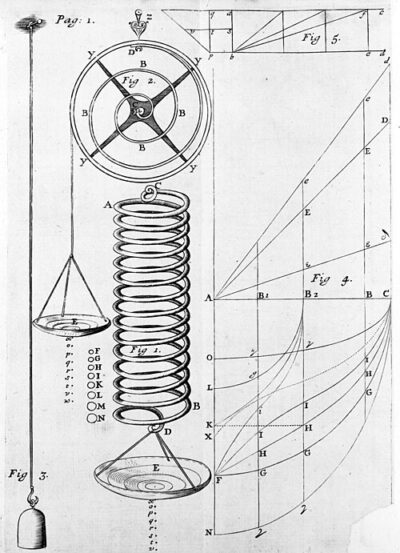
Hooke's law
Hooke's law is an empirical physical law of mechanics that the force on a spring is proportional to its displacement.
All 3 facts, and where they come from
Facts
3 facts · 0 confirmed by two sources · 0 cited · 3 from one source
Where this comes from
Papalocal keeps its own record. It started from these sources; what each one said is kept here as it was copied, so a change on their side never changes this page by itself. Tap one to read its version.
What Wikidata says · copied November 17, 2026 · revision 2550157668
- Described as
- empirical physical law of mechanics that the force on a spring is proportional to its displacement
- What it is
- physical law; empirical law · 1 reference
- Named after
- Robert Hooke
- Wikipedias with a page
- 71
Wikidata item Q170282 (wikidata.org/wiki/Q170282), public domain (CC0). Copied 2026-11-17.
What Wikipedia says · copied November 17, 2026 · revision 1382087743
In physics, Hooke's law is an empirical law which states that the force (F) needed to extend or compress a spring by some distance (x) scales linearly with respect to that distance—that is, Fs = kx, where k is a constant factor characteristic of the spring (i.e., its stiffness), and x is small compared to the total possible deformation of the spring.
The law is named after 17th-century British physicist Robert Hooke. He first stated the law in 1676 as a Latin anagram. He published the solution of his anagram in 1678 as: ut tensio, sic vis ("as the extension, so the force" or "the extension is proportional to the force"). Hooke states in the 1678 work that he was aware of the law since 1660. It is the fundamental principle behind the spring scale, the manometer, the galvanometer, and the balance wheel of the mechanical clock.
The equation holds in many situations where an elastic body is deformed. An elastic body or material for which this equation can be assumed is said to be linear-elastic or Hookean. Hooke's law is a first-order linear approximation to the real response of springs and other elastic bodies to applied forces. It fails once the forces exceed some limit, since no material can be compressed beyond a certain minimum size, or stretched beyond a maximum size, without some permanent deformation or change of state. Many materials will noticeably deviate from Hooke's law well before those elastic limits are reached.
From the Wikipedia article “Hooke's law” (en.wikipedia.org/wiki/Hooke's_law), by its contributors, under CC BY-SA 4.0 (creativecommons.org/licenses/by-sa/4.0/). Copied 2026-11-17; not changed.
Confirmed Two sources agree. Cited One source, and it names where it got it. One source One source, without a reference of its own. Sources disagree The sources disagree. We show the best-supported value and keep theirs below.
Picture: Robert Hooke, via Wikimedia Commons · Public domain