
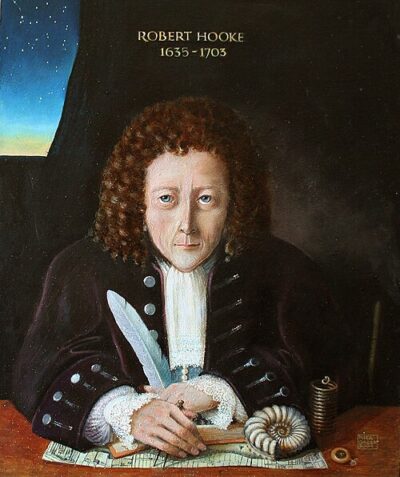
Robert Hooke
Robert Hooke was an English natural philosopher, architect and polymath (1635 — 1703). Born July 18, 1635, in Freshwater. Died March 3, 1703, in London. Positions held include secretary of the Royal Society (1677–1683). Known for Micrographia, Hooke's law and Church of St Mary Magdalene. Educated at Christ Church and Westminster School. Awards include Fellow of the Royal Society.
Facts
38 facts · 2 confirmed by two sources · 15 cited · 21 from one source
Where this comes from
Papalocal keeps its own record. It started from these sources; what each one said is kept here as it was copied, so a change on their side never changes this page by itself. Tap one to read its version.
What Wikidata says · copied November 16, 2026 · revision 2567360818
- Described as
- English natural philosopher, architect and polymath (1635 — 1703)
- Other names
- Hooke
- Born
- July 18, 1635 · 7 references
- Died
- March 3, 1703 · 11 references
- Born in
- Freshwater · 1 reference
- Died in
- London · 2 references
- Buried in
- St Helen's Bishopsgate · 1 reference
- Citizen of
- Kingdom of England
- Occupation
- architect · 1 reference; astronomer · 1 reference; physicist · 1 reference; diarist; university teacher; philosopher · 1 reference; inventor · 1 reference; biologist · 1 reference
- Positions held
- secretary of the Royal Society (1677–1683)
- Worked for
- Royal Society of London (1662–) · 2 references; Gresham College (1665–); City of London Corporation (1666–) · 1 reference; Robert Boyle (1655–1668) · 2 references
- Education
- Christ Church (1653–1655) · 1 reference; Westminster School (1648–1653) · 1 reference; University of Oxford (–1663) · 1 reference
- Member of
- Royal Society of London (1663–)
- Known for
- Micrographia (1665); Hooke's law; Church of St Mary Magdalene; Montagu House; Bethlem Royal Hospital at Moorfields
- Awards
- Fellow of the Royal Society (1663) · 1 reference
- Field
- mechanics; physics; chemistry; biology; architecture · 1 reference; astronomy
- Father
- John Hooke
- Mother
- Cecily Gyles · 1 reference
- Religion
- Anglicanism
- Wikipedias with a page
- 103
Wikidata item Q46830 (wikidata.org/wiki/Q46830), public domain (CC0). Copied November 16, 2026.
What Wikipedia says · copied November 16, 2026 · revision 1383787655
Robert Hooke (; 18 July 1635 – 3 March 1703) was an English polymath who was active as a physicist ('natural philosopher'), astronomer, geologist, meteorologist, and architect. He is credited as one of the first scientists to investigate living things at microscopic scale in 1665, using a compound microscope that he designed. Hooke was an impoverished scientific inquirer in young adulthood who went on to become one of the most important scientists of his time. After the Great Fire of London in 1666, Hooke (as a surveyor and architect) attained wealth and esteem by performing more than half of the property line surveys and assisting with the city's rapid reconstruction. Often vilified by writers in the centuries after his death, his reputation was restored at the end of the twentieth century and he has been called "England's Leonardo [da Vinci]".
Hooke was a Fellow of the Royal Society and from 1662, he was its first Curator of Experiments. From 1665 to 1703, he was also Professor of Geometry at Gresham College. Hooke began his scientific career as an assistant to the physical scientist Robert Boyle. Hooke built the vacuum pumps that were used in Boyle's experiments on gas law and also conducted experiments. In 1664, Hooke identified the rotations of Mars and Jupiter. Hooke's 1665 book Micrographia, in which he coined the term cell, encouraged microscopic investigations. Investigating optics – specifically light refraction – Hooke inferred a wave theory of light. His is the first-recorded hypothesis of the cause of the expansion of matter by heat, of air's composition by small particles in constant motion that thus generate its pressure, and of heat as energy.
In physics, Hooke inferred that gravity obeys an inverse square law and arguably was the first to hypothesise such a relation in planetary motion, a principle Isaac Newton furthered and formalised in Newton's law of universal gravitation. Priority over this insight contributed to the rivalry between Hooke and Newton. In geology and palaeontology, Hooke identified the organic origin and significance of fossils embedded in sedimentary rocks, thus questioning the Biblical view of the Earth's creation. His explanations for the origin of such fossils, some of which he identified as being of extinct species, presaged 19th-century arguments for biological evolution. He also argued that hills and mountains had become elevated by geological processes (rather than having been created exactly as they are today).
- Born, in its opening lines
- July 18, 1635
- Died, in its opening lines
- March 3, 1703
From the Wikipedia article “Robert Hooke” (en.wikipedia.org/wiki/Robert_Hooke), by its contributors, under CC BY-SA 4.0 (creativecommons.org/licenses/by-sa/4.0/). Copied November 16, 2026; not changed.
Confirmed Two sources agree. Cited One source, and it names where it got it. One source One source, without a reference of its own. Sources disagree The sources disagree. We show the best-supported value and keep theirs below.
