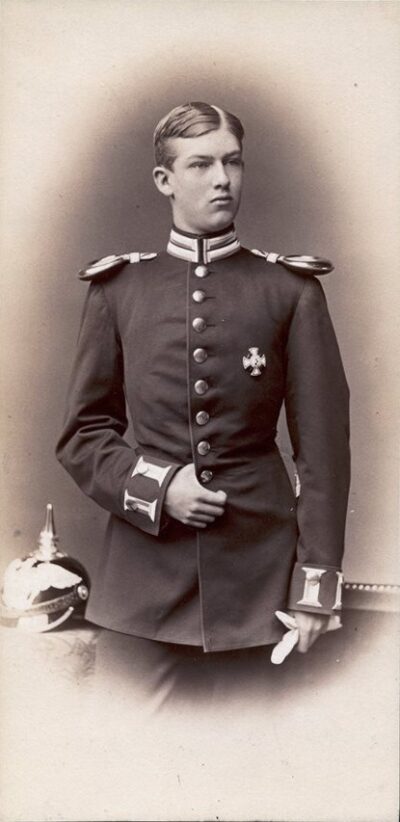
House of Hohenzollern
The House of Hohenzollern is a German royal and imperial dynasty. It was founded by Burkhard I, Count of Zollern and Frederick I, Count of Zollern. It won the 'Verschlossene Auster' award.
- Founded
- 11th century
- Founded by
- Burkhard I, Count of Zollern
- Country
- German Reich
All 9 facts, and where they come from
Facts
9 facts · 0 confirmed by two sources · 2 cited · 7 from one source
Where this comes from
Papalocal keeps its own record. It started from these sources; what each one said is kept here as it was copied, so a change on their side never changes this page by itself. Tap one to read its version.
What Wikidata says · copied November 18, 2026 · revision 2556298799
- Described as
- German royal and imperial dynasty
- Other names
- The Hohenzollerns, Hohenzollern
- What it is
- dynasty; noble family
- Founded
- 11th century
- Founded by
- Burkhard I, Count of Zollern; Frederick I, Count of Zollern · 1 reference
- Country
- German Reich · 1 reference; Holy Roman Empire · 1 reference
- Awards
- 'Verschlossene Auster' award (2021)
- Named after
- Hohenzollern Castle
- Wikipedias with a page
- 68
Wikidata item Q83969 (wikidata.org/wiki/Q83969), public domain (CC0). Copied 2026-11-18.
What Wikipedia says · copied November 18, 2026 · revision 1384512673
The House of Hohenzollern (, US also ; German: Haus Hohenzollern, pronounced [ˌhaʊs hoːənˈtsɔlɐn] ; Romanian: Casa de Hohenzollern) is a formerly royal (and from 1871 to 1918, imperial) German dynasty whose members were variously princes, electors, kings and emperors of Hohenzollern, Brandenburg, Prussia, the German Empire, and Romania. The family came from the area around the town of Hechingen in Swabia during the late 11th century and took their name from Hohenzollern Castle. The first ancestors of the Hohenzollerns were mentioned in 1061.
The Hohenzollern family split into two branches, the Catholic Swabian branch and the Protestant Franconian branch, which ruled the Burgraviate of Nuremberg and later became the Brandenburg–Prussian branch. The Swabian branch ruled the principalities of Hohenzollern-Hechingen and Hohenzollern-Sigmaringen until 1849, and also ruled Romania from 1866 to 1947. Members of the Franconian branch became Margrave of Brandenburg in 1415 and Duke of Prussia in 1525.
The Margraviate of Brandenburg and the Duchy of Prussia were ruled in personal union after 1618 and were called Brandenburg-Prussia. From there, the Kingdom of Prussia was created in 1701, eventually leading to the unification of Germany and the creation of the German Empire in 1871, with the Hohenzollerns as hereditary German Emperors and Kings of Prussia.
Germany's defeat in World War I in 1918 led to the German Revolution. The Hohenzollerns were overthrown and the Weimar Republic was established, thus bringing an end to the German and Prussian monarchy. Georg Friedrich, Prince of Prussia, is the current head of the formerly royal Prussian line; while Karl Friedrich, Prince of Hohenzollern, is the head of the formerly princely Swabian line.
From the Wikipedia article “House of Hohenzollern” (en.wikipedia.org/wiki/House_of_Hohenzollern), by its contributors, under CC BY-SA 4.0 (creativecommons.org/licenses/by-sa/4.0/). Copied 2026-11-18; not changed.
Confirmed Two sources agree. Cited One source, and it names where it got it. One source One source, without a reference of its own. Sources disagree The sources disagree. We show the best-supported value and keep theirs below.