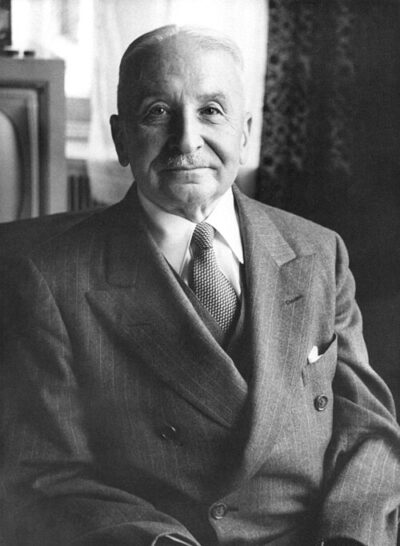
Human Action, a treatise on economics.
Human Action, a treatise on economics. is a non-fiction work by Ludwig von Mises. It came out in 1949.
- Published
- 1949
- Written by
- Ludwig von Mises
- Genre
- non-fiction literature
- Country of origin
- United States
All 7 facts, and where they come from
Facts
7 facts · 0 confirmed by two sources · 0 cited · 7 from one source
Where this comes from
Papalocal keeps its own record. It started from these sources; what each one said is kept here as it was copied, so a change on their side never changes this page by itself. Tap one to read its version.
What Wikidata says · copied November 16, 2026 · revision 2545820011
- Described as
- non-fiction work by Ludwig von Mises
- What it is
- written work
- Written by
- Ludwig von Mises
- Publisher
- Yale University Press
- Genre
- non-fiction literature
- Published
- 1949
- Language
- English
- Country of origin
- United States · 1 reference
- Wikipedias with a page
- 22
Wikidata item Q662732 (wikidata.org/wiki/Q662732), public domain (CC0). Copied 2026-11-16.
What Wikipedia says · copied November 16, 2026 · revision 1384224705
Human Action: A Treatise on Economics is a work by the Austrian economist and philosopher Ludwig von Mises. Widely considered Mises' magnum opus, it presents the case for laissez-faire capitalism based on praxeology, his method to understand the structure of human decision-making. Mises rejected positivism within economics, and defended an a priori foundation for praxeology, as well as methodological individualism and laws of self-evident certainty. Mises argues that the free-market economy not only outdistances any government-planned system, but ultimately serves as the foundation of civilization itself.
Nationalökonomie: Theorie des Handelns und Wirtschaftens is the 1940 German-language predecessor to Human Action.
Mises argues that market-generated money prices are essential to determine the most highly valued uses for resources to satisfy consumer demands. He attempts to demonstrate the inconsistencies of piecemeal political intervention in the market economy and the pernicious effects of political control and manipulation of the monetary system. In Mises's view, government interventions that distort market prices always result in misdirections of resources, including labor, and malinvestments of capital, leading to inflationary upswings followed by inevitable economic downturns. Mises believed that the market economy was the only system that provided freedom and personal choice to all members of society while generating the means for coordinating the actions of billions of people in the most economically rational manner, and that monetary manipulation by central banks was one of the most disruptive distortions to the process of economic calculation.
From the Wikipedia article “Human Action” (en.wikipedia.org/wiki/Human_Action), by its contributors, under CC BY-SA 4.0 (creativecommons.org/licenses/by-sa/4.0/). Copied 2026-11-16; not changed.
Confirmed Two sources agree. Cited One source, and it names where it got it. One source One source, without a reference of its own. Sources disagree The sources disagree. We show the best-supported value and keep theirs below.
Picture: Jeff Tucker, via Wikimedia Commons · CC BY-SA 3.0