
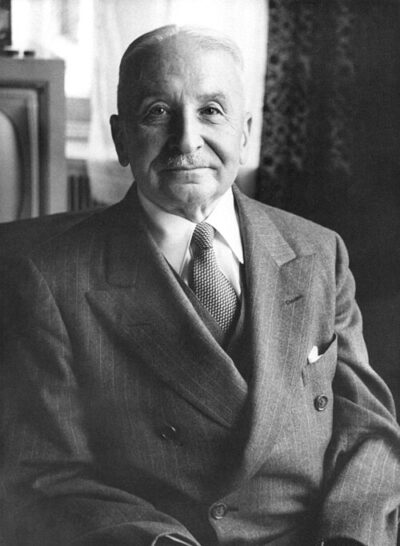
Ludwig von Mises
Ludwig von Mises was an Austrian-American economist. Born September 29, 1881, in Lviv. Died October 10, 1973, in New York City. Known for Human Action, a treatise on economics.. Educated at University of Vienna and Akademisches Gymnasium. Awards include Distinguished Fellow of the American Economic Association and Austrian Decoration for Science and Art.
Facts
27 facts · 2 confirmed by two sources · 6 cited · 19 from one source
Where this comes from
Papalocal keeps its own record. It started from these sources; what each one said is kept here as it was copied, so a change on their side never changes this page by itself. Tap one to read its version.
What Wikipedia says · copied November 13, 2026 · revision 1382043491
Ludwig Heinrich von Mises (; German: [ˈluːtvɪç fɔn ˈmiːzəs]; September 29, 1881 – October 10, 1973) was an Austrian and American political economist and philosopher of the Austrian school. Mises wrote and lectured extensively on the social contributions of classical liberalism and the central role of consumers in a market economy. He is best known for his work in praxeology, particularly for studies comparing communism and capitalism, as well as for being a defender of classical liberalism in the face of rising illiberalism and authoritarianism throughout much of Europe during the 20th century.
Since the mid-20th century, both libertarian and classical liberal movements, as well as the field of economics as a whole, have been strongly influenced by Mises's writings. Economist Tyler Cowen lists his writings as "the most important works of the 20th century" and as "among the most important economics articles, ever". Entire schools of thought trace their origins to Mises's early work, including the development of anarcho-capitalist philosophy through Murray Rothbard and the contemporary Austrian economics program led by scholars such as Peter Boettke at George Mason University.
Mises's most influential work, Human Action: A Treatise on Economics (1949), laid out his comprehensive theory of praxeology—a deductive, a priori method for understanding human decision-making and economic behavior. Rejecting empirical and mathematical modeling, Mises defended classical liberalism and market coordination as products of rational individual action. Beyond his published works, Mises shaped generations of economists through his longstanding private seminar in Vienna and later as a professor at New York University. His ideas deeply influenced students such as Friedrich Hayek, Murray Rothbard, and Israel Kirzner, all of whom helped inspire the rise of postwar libertarian institutions in the United States, including the Foundation for Economic Education and the Ludwig von Mises Institute.
Mises received many honors throughout the course of his lifetime—honorary doctorates from Grove City College (1957), New York University (1963), and the University of Freiburg (1964) in Germany. His accomplishments were recognized in 1956 by his alma mater, the University of Vienna, when his doctorate was memorialized on its 50th anniversary and "renewed", a European tradition, and in 1962 by the Austrian government. He was also cited in 1969 as "Distinguished Fellow" by the American Economic Association.
- Born, in its opening lines
- September 29, 1881
- Died, in its opening lines
- October 10, 1973
From the Wikipedia article “Ludwig von Mises” (en.wikipedia.org/wiki/Ludwig_von_Mises), by its contributors, under CC BY-SA 4.0 (creativecommons.org/licenses/by-sa/4.0/). Copied November 13, 2026; not changed.
What Wikidata says · copied November 14, 2026 · revision 2568956527
- Described as
- Austrian-American economist (1881–1973)
- Other names
- Ludwig Heinrich Edler von Mises, Ludwig Heinrich Mises
- Born
- September 29, 1881 · 10 references
- Died
- October 10, 1973 · 8 references
- Born in
- Lviv · 2 references
- Died in
- New York City · 3 references
- Buried in
- Ferncliff Cemetery
- Citizen of
- United States; Austria
- Occupation
- economist · 1 reference; philosopher; university teacher; writer · 1 reference
- Political party
- Fatherland Front (1934) · 1 reference
- Worked for
- University of Vienna (1919–1934); New York University (1945–1969); Graduate Institute of International Studies (1934–1940) · 1 reference
- Education
- University of Vienna (1900–1906); Akademisches Gymnasium
- Member of
- Mont Pelerin Society
- Known for
- Human Action, a treatise on economics.
- Awards
- Distinguished Fellow of the American Economic Association; Austrian Decoration for Science and Art (1962)
- Field
- economics; philosophy
- Spouse
- Margit von Mises · 1 reference
- Father
- Arthur Edler von Mises
- Mother
- Adele Edle von Mises
- Siblings
- Richard von Mises · 1 reference
- Wikipedias with a page
- 79
Wikidata item Q84233 (wikidata.org/wiki/Q84233), public domain (CC0). Copied November 14, 2026.
Confirmed Two sources agree. Cited One source, and it names where it got it. One source One source, without a reference of its own. Sources disagree The sources disagree. We show the best-supported value and keep theirs below.
