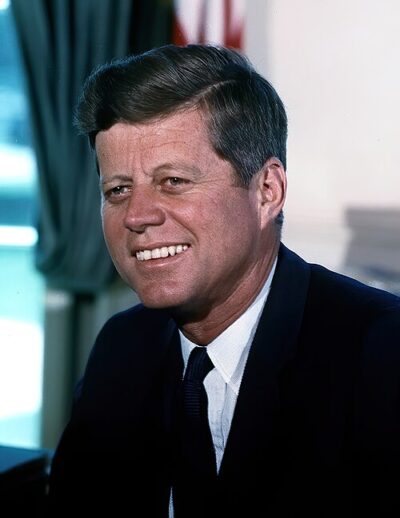
Ich bin ein Berliner
Ich bin ein Berliner is a speech given by John F. Kennedy in West Berlin in June 1963.
- Released
- 1963
- Came out
- June 26, 1963
- Written by
- John F. Kennedy
All 7 facts, and where they come from
Facts
7 facts · 0 confirmed by two sources · 0 cited · 7 from one source
Where this comes from
Papalocal keeps its own record. It started from these sources; what each one said is kept here as it was copied, so a change on their side never changes this page by itself. Tap one to read its version.
What Wikidata says · copied November 16, 2026 · revision 2517826246
- Described as
- speech given by John F. Kennedy in West Berlin in June 1963
- Other names
- I am a Berliner, Remarks of President John F. Kennedy at the Rudolph Wilde Platz
- What it is
- political slogan; oration
- Written by
- John F. Kennedy
- Released
- 1963
- Language
- English
- Came out
- June 26, 1963
- Country
- Germany
- Wikipedias with a page
- 52
Wikidata item Q443 (wikidata.org/wiki/Q443), public domain (CC0). Copied 2026-11-16.
What Wikipedia says · copied November 16, 2026 · revision 1384352792
"Ich bin ein Berliner" (German pronunciation: [ɪç bɪn ʔaɪn bɛʁˈliːnɐ]; "I Am a Berliner") is a speech by United States president John F. Kennedy given on June 26, 1963, in West Berlin. It is one of the best-known speeches of the Cold War and among the most famous anti-communist speeches. The speech is considered one of Kennedy's finest, delivered at the height of the Cold War and the New Frontier.
Twenty-two months earlier, East Germany had erected the Berlin Wall to prevent mass emigration to West Berlin. The speech was aimed as much at the Soviet Union as it was at West Berliners. Another phrase in the speech was also spoken in German, "Lasst sie nach Berlin kommen" ("Let them come to Berlin"), addressed at those who claimed "we can work with the Communists", a remark at which Nikita Khrushchev scoffed only days later.
Speaking to an audience of 120,000 on the steps of Rathaus Schöneberg, Kennedy said,Two thousand years ago, the proudest boast was civis Romanus sum ["I am a Roman citizen"]. Today, in the world of freedom, the proudest boast is "Ich bin ein Berliner!"... All free men, wherever they may live, are citizens of Berlin, and therefore, as a free man, I take pride in the words "Ich bin ein Berliner!"
For decades, competing claims about the origins of the "Ich bin ein Berliner" overshadowed the history of the speech. In 2008, historian Andreas Daum provided a comprehensive explanation, based on archival sources and interviews with contemporaries and witnesses. He highlighted the authorship of Kennedy himself and his 1962 speech in New Orleans as a precedent, and demonstrated that by straying from the prepared script in Berlin, Kennedy created the climax of an emotionally charged political performance, which became a hallmark of the Cold War epoch.
There is a widespread misconception that Kennedy accidentally said that he was a Berliner, a type of German doughnut. This is an urban legend which emerged two decades after the speech, and it is not true that residents of Berlin in 1963 would have mainly understood the word "Berliner" to refer to a jelly doughnut or that the audience laughed at Kennedy's use of this expression – if nothing else because this type of doughnut is called "Pfannkuchen" (literally: Pan cake) in Berlin and the word "Berliner" is only used outside Berlin.
From the Wikipedia article “Ich bin ein Berliner” (en.wikipedia.org/wiki/Ich_bin_ein_Berliner), by its contributors, under CC BY-SA 4.0 (creativecommons.org/licenses/by-sa/4.0/). Copied 2026-11-16; not changed.
Confirmed Two sources agree. Cited One source, and it names where it got it. One source One source, without a reference of its own. Sources disagree The sources disagree. We show the best-supported value and keep theirs below.
Picture: Wikimedia Commons: 1963-Schöneberg.jpg · See Commons file page