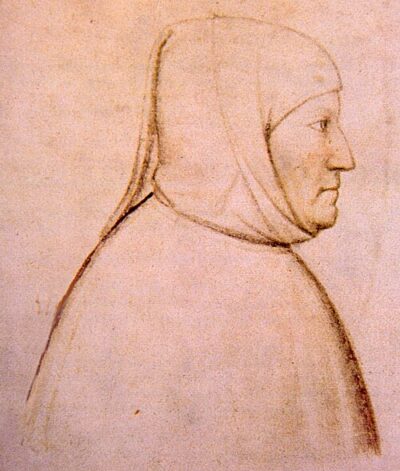
Il Canzoniere
Il Canzoniere is a poetry anthology by Petrarch. It came out in 1336.
All 7 facts, and where they come from
Facts
7 facts · 0 confirmed by two sources · 0 cited · 7 from one source
Where this comes from
Papalocal keeps its own record. It started from these sources; what each one said is kept here as it was copied, so a change on their side never changes this page by itself. Tap one to read its version.
What Wikidata says · copied November 17, 2026 · revision 2560775000
- Described as
- poetry anthology by Petrarch
- Other names
- Song Book
- What it is
- literary work
- Written by
- Petrarch
- Genre
- chansonnier · 1 reference
- Published
- 1336
- Language
- Italian
- Country of origin
- Italy
- Came out
- 1304
- Wikipedias with a page
- 31
Wikidata item Q777574 (wikidata.org/wiki/Q777574), public domain (CC0). Copied 2026-11-17.
What Wikipedia says · copied November 17, 2026 · revision 1381316014
Il Canzoniere (Italian pronunciation: [il kantsoˈnjɛːre]; English: Song Book), also known as the Rime Sparse (English: Scattered Rhymes), but originally titled Rerum vulgarium fragmenta (English: Fragments of common things, that is Fragments composed in vernacular), is a collection of poems written in the Italian language by Petrarch.
Though the majority of Petrarch's output was in Latin, the Canzoniere was written in the vernacular, a language of trade, despite Petrarch's view that Italian was less adequate for expression. Of its 366 poems, the vast majority are in sonnet form (317), though the sequence contains a number of canzoni (29), sestine (9), madrigals (4), and ballate (7). Its central theme is the poet's love for Laura, a woman Petrarch allegedly met on April 6, 1327, in the Church of Sainte Claire in Avignon. Though disputed, the inscription in his copy of Virgil records this information. Petrarch's meticulous dating of his manuscripts has allowed scholars to deduce that the poems were written over a period of forty years, with the earliest dating from shortly after 1327, and the latest around 1368. The transcription and ordering of the sequence itself went on until 1374, the year of the poet's death. The two sections of the sequence which are divided by Laura's death have traditionally been labelled 'In vita' (In life') and 'In morte' (In death) respectively, though Petrarch made no such distinction. His work would go on to become what Spiller calls 'the single greatest influence on the love poetry of Renaissance Europe until well into the seventeenth century'.
From the Wikipedia article “Il Canzoniere” (en.wikipedia.org/wiki/Il_Canzoniere), by its contributors, under CC BY-SA 4.0 (creativecommons.org/licenses/by-sa/4.0/). Copied 2026-11-17; not changed.
Confirmed Two sources agree. Cited One source, and it names where it got it. One source One source, without a reference of its own. Sources disagree The sources disagree. We show the best-supported value and keep theirs below.
Picture: Wikimedia Commons: Manuscrito de Petrarca.jpg · See Commons file page