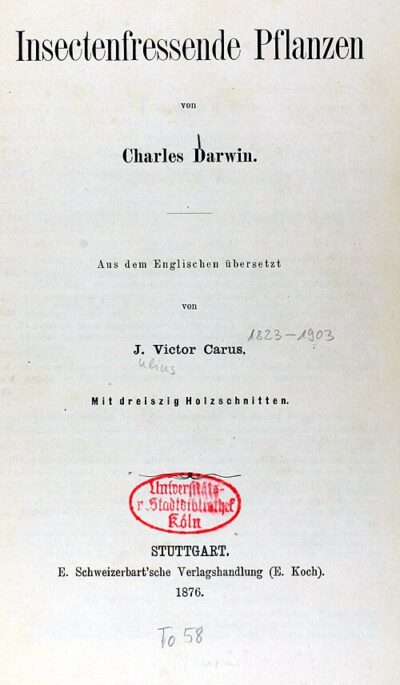
Insectivorous Plants
Insectivorous Plants is a book published by Charles Darwin in 1875.
- Published
- 1875
- Written by
- Charles Darwin
- Country of origin
- United Kingdom
All 6 facts, and where they come from
Facts
6 facts · 0 confirmed by two sources · 0 cited · 6 from one source
Where this comes from
Papalocal keeps its own record. It started from these sources; what each one said is kept here as it was copied, so a change on their side never changes this page by itself. Tap one to read its version.
What Wikidata says · copied November 17, 2026 · revision 2547514261
- Described as
- book published by Charles Darwin in 1875
- What it is
- written work
- Written by
- Charles Darwin
- Publisher
- John Murray
- Published
- 1875
- Language
- English
- Country of origin
- United Kingdom · 1 reference
- Wikipedias with a page
- 13
Wikidata item Q941356 (wikidata.org/wiki/Q941356), public domain (CC0). Copied 2026-11-17.
What Wikipedia says · copied November 17, 2026 · revision 1384336871
Insectivorous Plants is a book by British naturalist and evolutionary theory pioneer Charles Darwin, first published on 2 July 1875 in London.
Part of a series of works by Darwin related to his theory of natural selection, the book is a study of carnivorous plants with specific attention paid to the adaptations that allow them to live in difficult conditions. It includes illustrations by Darwin himself, along with drawings by his sons George and Francis Darwin.
The book chronicles Darwin's experiments with various carnivorous plants, in which he carefully studied their feeding mechanisms. Darwin tried several methods to stimulate the plants into activating their trap mechanisms, including feeding them meat and glass, blowing on them, and prodding them with hair. He found that only the movement of an animal would cause the plants to react, and concluded that this was an evolutionary adaptation to conserve energy for prey and to ignore stimuli that were not likely to be nutritious. He also discovered that while some plants have distinct trap-like structures, others produce sticky fluids to ensnare their prey and concluded that this was an example of natural selection pressure resulting in various methods for food capture.
The first edition had a reported printing of 3,000 copies. It was translated into several languages during Darwin's lifetime, including German. A second English-language edition was published in 1888 after Darwin's death. It was edited with additions and footnotes by Francis Darwin.
From the Wikipedia article “Insectivorous Plants” (en.wikipedia.org/wiki/Insectivorous_Plants), by its contributors, under CC BY-SA 4.0 (creativecommons.org/licenses/by-sa/4.0/). Copied 2026-11-17; not changed.
Confirmed Two sources agree. Cited One source, and it names where it got it. One source One source, without a reference of its own. Sources disagree The sources disagree. We show the best-supported value and keep theirs below.
Picture: Charles Darwin, Victor Carus (translation), via Wikimedia Commons · Public domain