
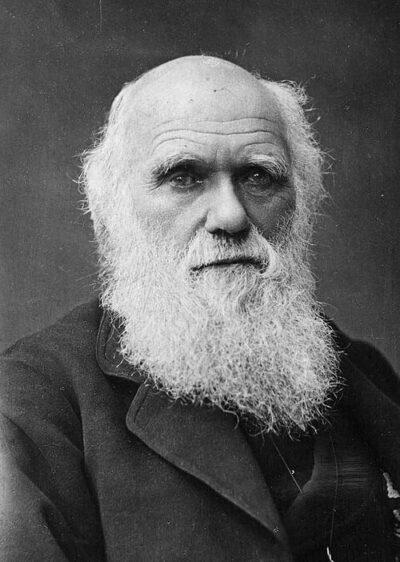
Charles Darwin
Charles Darwin was an English naturalist and biologist. Born February 12, 1809, in The Mount. Died April 19, 1882, in Down House. Known for On the Tendency of Species to form Varieties; and on the Perpetuation of Varieties and Species by Natural Means of Selection, On the Origin of Species and The Voyage of the Beagle. Educated at Christ's College and University of Edinburgh Medical School. Awards include Royal Medal, Copley Medal and Pour le Mérite for Sciences and Arts order.
Facts
75 facts · 2 confirmed by two sources · 38 cited · 35 from one source
Where this comes from
Papalocal keeps its own record. It started from these sources; what each one said is kept here as it was copied, so a change on their side never changes this page by itself. Tap one to read its version.
What Wikidata says · copied November 16, 2026 · revision 2569135865
- Described as
- English naturalist and biologist (1809–1882)
- Other names
- Darwin, C.R. Darwin, Charles R. Darwin, CR Darwin, C. R. Darwin, Charles Robert Darwin
- Born
- February 12, 1809 · 20 references
- Died
- April 19, 1882 · 19 references
- Born in
- The Mount · 1 reference
- Died in
- Down House · 1 reference
- Buried in
- Westminster Abbey · 1 reference
- Name at birth
- Charles Robert Darwin
- Citizen of
- United Kingdom of Great Britain and Ireland
- Occupation
- geologist · 2 references; explorer; travel writer; ethologist; naturalist · 2 references; philosopher · 1 reference; writer · 1 reference; botanist · 1 reference
- Worked for
- Royal Geographical Society · 1 reference
- Education
- Christ's College; University of Edinburgh Medical School; Shrewsbury School (1818–1825) · 1 reference; University of Cambridge (1828–) · 1 reference; University of Edinburgh (1825–) · 1 reference
- Member of
- Royal Society of London (1839–); German Academy of Sciences Leopoldina (1857–) · 1 reference; Royal Swedish Academy of Sciences; American Philosophical Society (1869–) · 1 reference; Hungarian Academy of Sciences; Silesian Society for the Culture of the Fatherland; American Academy of Arts and Sciences (1874–) · 1 reference; Royal Netherlands Academy of Arts and Sciences; Accademia Nazionale dei Lincei (1875–) · 1 reference; Zoological Society of London (1839–) · 1 reference
- Known for
- On the Tendency of Species to form Varieties; and on the Perpetuation of Varieties and Species by Natural Means of Selection; On the Origin of Species; The Voyage of the Beagle; The Descent of Man, and Selection in Relation to Sex; The Expression of the Emotions in Man and Animals; Insectivorous Plants; The Power of Movement in Plants; The Formation of Vegetable Mould through the Action of Worms
- Awards
- Royal Medal (1853); Copley Medal (1864) · 1 reference; Pour le Mérite for Sciences and Arts order (1868) · 1 reference; Fellow of the Linnean Society of London; Fellow of the Royal Geographical Society; Fellow of the Royal Society; Baly Medal (1879); Fellow of the Geological Society of London · 1 reference; Bressa Prize (1875) · 1 reference; Honorary doctor of Leiden University (1875) · 1 reference; Wollaston Medal (1859) · 1 reference; Honorary Fellow of the Royal Society Te Apārangi (1871–) · 1 reference
- Field
- biology · 1 reference; natural history; zoology
- Spouse
- Emma Darwin (1839–1882) · 2 references
- Children
- William Erasmus Darwin · 1 reference; Anne Darwin · 1 reference; Mary Eleanor Darwin · 1 reference; Henrietta Litchfield · 1 reference; George Howard Darwin · 1 reference; Elizabeth Darwin · 1 reference; Francis Darwin · 1 reference; Leonard Darwin · 1 reference; Horace Darwin · 1 reference; Charles Waring Darwin · 1 reference
- Father
- Robert Darwin · 2 references
- Mother
- Susannah Wedgwood · 2 references
- Siblings
- Erasmus Alvey Darwin · 1 reference; Caroline Wedgwood · 1 reference; Marianne Darwin · 1 reference; Emily Darwin · 1 reference; Susan Darwin · 1 reference
- Religion
- Anglicanism; agnosticism · 1 reference
- Lived in
- The Mount
- Wikipedias with a page
- 280
Wikidata item Q1035 (wikidata.org/wiki/Q1035), public domain (CC0). Copied November 16, 2026.
What Wikipedia says · copied November 16, 2026 · revision 1382397901
Charles Robert Darwin ( DAR-win; 12 February 1809 – 19 April 1882) was an English naturalist, geologist, and biologist, widely known for his contributions to evolutionary biology. His proposition that all species have descended from a common ancestor is now accepted and considered a fundamental scientific concept. In a joint presentation with Alfred Russel Wallace, he proposed that this branching pattern of evolution resulted from a process he called natural selection, in which the struggle for existence has a similar effect to the artificial selection involved in selective breeding. Darwin has been described as one of the most influential figures in human history and was honoured by burial in Westminster Abbey.
Darwin's early interest in nature led him to neglect his medical education at the University of Edinburgh; instead, he helped Robert Edmond Grant to investigate marine invertebrates. His studies at the University of Cambridge's Christ's College from 1828 to 1831 encouraged his passion for natural science. However, it was his five-year voyage on HMS Beagle from 1831 to 1836 that established Darwin as an eminent geologist. The observations he made during his voyage supported Charles Lyell's concept of gradual geological change. The Voyage of the Beagle (1839), Darwin's travel journal, made him a popular author. His first scientific work was The Structure and Distribution of Coral Reefs (1842). Along with his work on barnacles, it won him the Royal Medal in 1853.
Puzzled by the geographical distribution of wildlife and fossils he collected on the voyage, Darwin began detailed investigations and, in 1838, devised his theory of natural selection. Although he discussed his ideas with several naturalists, he needed time for extensive research, and his geological work had priority. He was writing up his theory in 1858 when Wallace sent him an essay outlining the same idea, prompting the joint submission of "On the Tendency of Species to form Varieties; and on the Perpetuation of Varieties and Species by Natural Means of Selection" to the Linnean Society of London. Darwin's work established descent with modification as the scientific explanation of natural diversity. Darwin published his theory of evolution with compelling evidence in On the Origin of Species (1859). He explored coevolution in Fertilisation of Orchids (1862) and human evolution and sexual selection in The Descent of Man, and Selection in Relation to Sex (1871). The Expression of the Emotions in Man and Animals (1872) was an early work of psychology, and one of the first books to feature photographs. His final book was The Formation of Vegetable Mould, through the Actions of Worms (1881).
By the 1870s, the scientific community and a majority of the educated public had accepted evolution as a fact. However, many initially favoured competing explanations that gave only a minor role to natural selection. It was not until the emergence of the modern evolutionary synthesis from the 1930s to the 1950s that a broad consensus developed in which natural selection was the basic mechanism of evolution. Darwin's discovery is the unifying theory of the life sciences, explaining the unity and diversity of life.
- Born, in its opening lines
- February 12, 1809
- Died, in its opening lines
- April 19, 1882
From the Wikipedia article “Charles Darwin” (en.wikipedia.org/wiki/Charles_Darwin), by its contributors, under CC BY-SA 4.0 (creativecommons.org/licenses/by-sa/4.0/). Copied November 16, 2026; not changed.
Confirmed Two sources agree. Cited One source, and it names where it got it. One source One source, without a reference of its own. Sources disagree The sources disagree. We show the best-supported value and keep theirs below.
