Iphigénie en Aulide
Iphigénie en Aulide is an opera by Christoph Willibald Gluck.
- Released
- 18th century
- Genre
- opera
All 8 facts, and where they come from
Facts
8 facts · 0 confirmed by two sources · 3 cited · 5 from one source
Where this comes from
Papalocal keeps its own record. It started from these sources; what each one said is kept here as it was copied, so a change on their side never changes this page by itself. Tap one to read its version.
What Wikidata says · copied November 17, 2026 · revision 2463434572
- Described as
- opera by Christoph Willibald Gluck
- Other names
- Iphigenie en Aulide, Ifigenia in Aulide
- What it is
- dramatico-musical work
- Music by
- Christoph Willibald von Gluck · 1 reference
- Screenplay by
- Jean Racine · 1 reference
- Genre
- opera · 1 reference
- Released
- 18th century
- Language
- French
- Based on
- Iphigénie
- Named after
- Iphigenia · 1 reference
- Wikipedias with a page
- 17
Wikidata item Q248892 (wikidata.org/wiki/Q248892), public domain (CC0). Copied 2026-11-17.
What Wikipedia says · copied November 17, 2026 · revision 1384355099
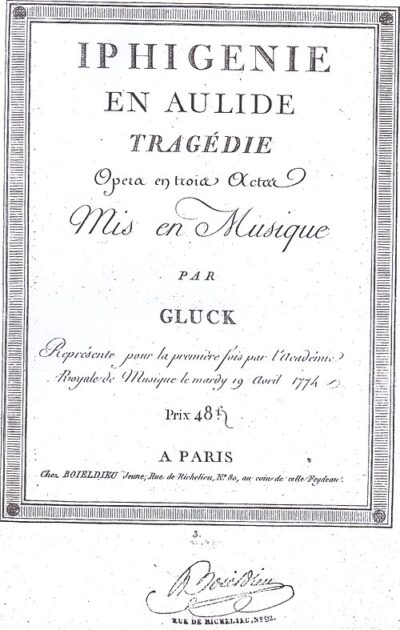
Iphigénie en Aulide (Iphigeneia in Aulis) is an opera in three acts by Christoph Willibald Gluck, the first work he wrote for the Paris stage. The libretto was written by François-Louis Gand Le Bland Du Roullet and was based on Jean Racine's tragedy Iphigénie, itself based on the play Iphigenia in Aulis by Euripides. It was premiered on 19 April 1774 by the Paris Opéra in the second Salle du Palais-Royal and revived in a slightly revised version the following year.
A German version was made in 1847 by Richard Wagner, with significant alterations.
From the Wikipedia article “Iphigénie en Aulide” (en.wikipedia.org/wiki/Iphigénie_en_Aulide), by its contributors, under CC BY-SA 4.0 (creativecommons.org/licenses/by-sa/4.0/). Copied 2026-11-17; not changed.
Confirmed Two sources agree. Cited One source, and it names where it got it. One source One source, without a reference of its own. Sources disagree The sources disagree. We show the best-supported value and keep theirs below.
Picture: Editore Boieldieu Jeune, Rue de Richelieu, 80, Parigi, via Wikimedia Commons · Public domain