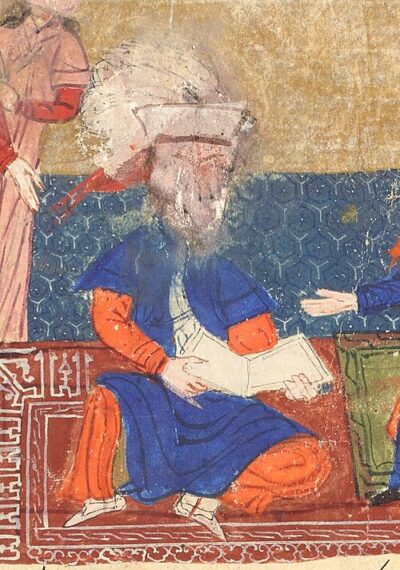
Jami' al-tawarikh
Jami' al-tawarikh is a work of literature and history, produced in the Mongol Ilkhanate. It was written by Rashid-al-Din Hamadani.
- Released
- 14th century
- Written by
- Rashid-al-Din Hamadani
- Genre
- history book
- Country of origin
- Ilkhanate
All 8 facts, and where they come from
Facts
8 facts · 0 confirmed by two sources · 0 cited · 8 from one source
Where this comes from
Papalocal keeps its own record. It started from these sources; what each one said is kept here as it was copied, so a change on their side never changes this page by itself. Tap one to read its version.
What Wikidata says · copied November 17, 2026 · revision 2568355007
- Described as
- work of literature and history, produced in the Mongol Ilkhanate
- Other names
- Compendium of Chronicles, Jami al-Tawarikh
- What it is
- reference work
- Written by
- Rashid-al-Din Hamadani
- Genre
- history book
- Released
- 14th century
- Language
- Persian; Arabic
- Country of origin
- Ilkhanate
- Country
- Ilkhanate
- Wikipedias with a page
- 34
Wikidata item Q1262004 (wikidata.org/wiki/Q1262004), public domain (CC0). Copied 2026-11-17.
What Wikipedia says · copied November 17, 2026 · revision 1384297599
Jāmiʿ al-Tawārīkh (lit. 'The Compendium of Chronicles') is a work of literature and history, produced in the Mongol Ilkhanate. Written by Rashid al-Din Hamadani (1247–1318 AD) at the start of the 14th century, the breadth of coverage of the work has caused it to be called "the first world history". It was in three volumes and published in Arabic and Persian versions. The extant manuscripts represent "one of the most important surviving examples of Ilkhanid art in any medium", and are the largest surviving body of early examples of the Persian miniature.
The work describes cultures and major events in world history from China to Europe, while spotlighting Mongol history with a view to securing the Mongol Empire's cultural legacy. The lavish illustrations and calligraphy required the efforts of hundreds of scribes and artists, with the intent that two new copies (one in Persian, and one in Arabic) would be created each year and distributed to schools and cities around the Ilkhanate, in the Middle East, Central Asia, Anatolia, and the Indian subcontinent.
Approximately 20 illustrated copies were made of the work during Rashid al-Din's lifetime, but only parts have survived, covering roughly 400 pages of the original work. The oldest known copy is an Arabic version, of which half has been lost, but one set of pages is currently in the Khalili Collection of Islamic Art (London, England), comprising 59 folios from the second volume of the work. Another set of pages, with 151 folios from the same volume, is owned by the Edinburgh University Library. Two Persian copies from the first generation of manuscripts survive in the Topkapı Palace Library in Istanbul.
From the Wikipedia article “Jami' al-tawarikh” (en.wikipedia.org/wiki/Jami'_al-tawarikh), by its contributors, under CC BY-SA 4.0 (creativecommons.org/licenses/by-sa/4.0/). Copied 2026-11-17; not changed.
Confirmed Two sources agree. Cited One source, and it names where it got it. One source One source, without a reference of its own. Sources disagree The sources disagree. We show the best-supported value and keep theirs below.
Picture: Wikimedia Commons: Page from the "Jāmi‘ al-Tavārīkh" with heading in the hand of Baysunghur.jpg · See Commons file page