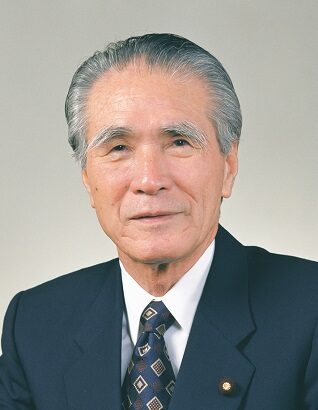
Japanese Socialist Party
The Japanese Socialist Party is a former Japanese political party (1945–1996). Its headquarters are in Nagatachō. It stands for socialism, social democracy and pacifism.
- Country
- Japan
- Founded
- November 2, 1945
- Ideology
- socialism
All 9 facts, and where they come from
Facts
9 facts · 0 confirmed by two sources · 0 cited · 9 from one source
Where this comes from
Papalocal keeps its own record. It started from these sources; what each one said is kept here as it was copied, so a change on their side never changes this page by itself. Tap one to read its version.
What Wikidata says · copied November 17, 2026 · revision 2565997908
- Described as
- former Japanese political party (1945–1996)
- Other names
- JSP, Japan Socialist Party, Socialist Party of Japan, Nihon Shakaitō, Social Democratic Party of Japan, SP
- What it is
- defunct political party
- Founded
- November 2, 1945
- Ended
- January 19, 1996
- Headquarters
- Nagatachō (1964–1996)
- Country
- Japan
- Ideology
- socialism; social democracy; pacifism; Marxism
- Wikipedias with a page
- 17
Wikidata item Q1144146 (wikidata.org/wiki/Q1144146), public domain (CC0). Copied 2026-11-17.
What Wikipedia says · copied November 17, 2026 · revision 1386215472
The Japan Socialist Party (Japanese: 日本社会党, Hepburn: Nihon Shakai-tō; JSP) was a major socialist, progressive, and left-wing political party in Japan. Established in 1945, the party was the primary representative of the Japanese left and main opponent of the right-wing Liberal Democratic Party for most of its existence.
The JSP was founded in 1945 by members of pre-war proletarian parties, including the Shakai Taishūtō. In the 1947 election, the JSP became the largest party in the National Diet and formed a government under Tetsu Katayama until 1948. From 1951 to 1955, the JSP was split into the Left Socialist Party and the Right Socialist Party, and in 1960 some of its members broke away to form the rival Democratic Socialist Party. In 1955, Japan's two major conservative parties merged to form the Liberal Democratic Party (LDP), which has held power near-continuously since. The JSP was the largest opposition party for the next 40 years, but was incapable of forming a government. Nonetheless, it managed to hold about one third of the seats in the National Diet during this period, preventing the LDP from revising the Constitution of Japan.
Under the leadership of Takako Doi, the JSP achieved brief resurgence in the 1990 election before losing many of its seats in the 1993 election. In 1994, JSP leader Tomiichi Murayama became prime minister of a coalition government before the coalition collapsed in 1996. The JSP's period in the government alienated many of its traditional supporters, and it was reconstituted in 1996 as the Social Democratic Party, which became a minor party. The Democratic Party of Japan replaced the JSP as the main opposition to the LDP.
From the Wikipedia article “Japan Socialist Party” (en.wikipedia.org/wiki/Japan_Socialist_Party), by its contributors, under CC BY-SA 4.0 (creativecommons.org/licenses/by-sa/4.0/). Copied 2026-11-17; not changed.
Confirmed Two sources agree. Cited One source, and it names where it got it. One source One source, without a reference of its own. Sources disagree The sources disagree. We show the best-supported value and keep theirs below.