
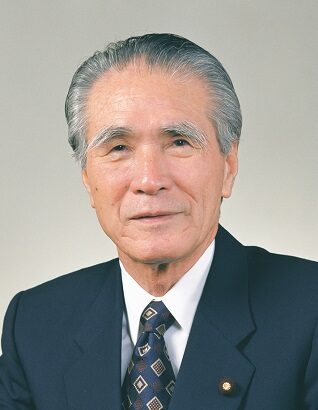
Tomiichi Murayama
Tomiichi Murayama was the 81st Prime Minister of Japan. Born March 3, 1924, in Ōita-shi. Died October 17, 2025, in Ōita-shi. Positions held include Prime Minister of Japan (1994–1996), member of the House of Representatives of Japan (2 times) (1972–2000) and member of the Ōita Prefectural Assembly (1963–1972). Educated at Meiji University. Awards include Grand Cordon of the Order of the Paulownia Flowers and Grand Cordon of the Supreme Order of the Chrysanthemum.
Facts
21 facts · 2 confirmed by two sources · 7 cited · 12 from one source
Where this comes from
Papalocal keeps its own record. It started from these sources; what each one said is kept here as it was copied, so a change on their side never changes this page by itself. Tap one to read its version.
What Wikidata says · copied November 16, 2026 · revision 2567780408
- Described as
- 81st Prime Minister of Japan (1924–2025)
- Born
- March 3, 1924 · 1 reference
- Died
- October 17, 2025 · 2 references
- Born in
- Ōita-shi · 1 reference
- Died in
- Ōita-shi · 1 reference
- Cause of death
- senility · 1 reference
- Citizen of
- Japan
- Occupation
- politician · 1 reference; head of government · 1 reference
- Positions held
- Prime Minister of Japan (1994–1996) · 2 references; member of the House of Representatives of Japan (2 times) (1972–2000); member of the Ōita Prefectural Assembly (1963–1972); Leader of the Social Democratic Party
- Political party
- Japanese Socialist Party (1948–1996); Social Democratic Party (1996–2025)
- Education
- Meiji University (1946)
- Awards
- Grand Cordon of the Order of the Paulownia Flowers (2006) · 1 reference; Grand Cordon of the Supreme Order of the Chrysanthemum (2025)
- Spouse
- Yoshie Murayama (1953–2024)
- Military branch
- Imperial Japanese Army
- Military rank
- officer candidate · 1 reference; Sergeant
- Wikipedias with a page
- 57
Wikidata item Q310126 (wikidata.org/wiki/Q310126), public domain (CC0). Copied November 16, 2026.
What Wikipedia says · copied November 16, 2026 · revision 1381824549
Tomiichi Murayama (村山 富市, Murayama Tomiichi; 3 March 1924 – 17 October 2025) was a Japanese politician who served as Prime Minister of Japan from 1994 to 1996. He was the country's only socialist premier since Tetsu Katayama in 1948, and is best remembered for the Murayama Statement on the 50th anniversary of the end of World War II, in which he officially apologized for Japan's past colonial wars and aggression.
Born in Ōita Prefecture, Murayama graduated from Meiji University in 1946, and became a labor union official in his home prefecture. He was elected to the Ōita City Council in 1955 as a member of the Japan Socialist Party; he was then elected to the Ōita Prefectural Assembly in 1963 and to the National Diet in 1972.
After the JSP joined the government following the 1993 election, he became its leader, then became prime minister in 1994 as the head of a new coalition of the JSP, Liberal Democratic Party, and New Party Sakigake. During his time as prime minister, Murayama was noted for his Murayama Statement in which he apologised for the country's actions during World War II, oversaw a crumbling relationship between Japan and the United States, and his government was criticized for its responses to the Great Hanshin earthquake and Tokyo subway sarin attack in 1995. He resigned as prime minister in 1996, and reorganized the JSP as the Social Democratic Party. The new party lost many of its seats in the 1996 election, and he resigned as its leader soon after.
- Born, in its opening lines
- March 3, 1924
- Died, in its opening lines
- October 17, 2025
From the Wikipedia article “Tomiichi Murayama” (en.wikipedia.org/wiki/Tomiichi_Murayama), by its contributors, under CC BY-SA 4.0 (creativecommons.org/licenses/by-sa/4.0/). Copied November 16, 2026; not changed.
Confirmed Two sources agree. Cited One source, and it names where it got it. One source One source, without a reference of its own. Sources disagree The sources disagree. We show the best-supported value and keep theirs below.
