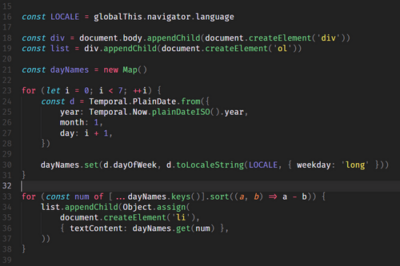
JavaScript
JavaScript is a high-level programming language. It came out in 1995. It is based on ECMAScript.
- Released
- September 1995
- Came out
- December 4, 1995
All 10 facts, and where they come from
Facts
10 facts · 0 confirmed by two sources · 4 cited · 6 from one source
Where this comes from
Papalocal keeps its own record. It started from these sources; what each one said is kept here as it was copied, so a change on their side never changes this page by itself. Tap one to read its version.
What Wikidata says · copied November 17, 2026 · revision 2566877768
- Described as
- high-level programming language
- Other names
- JS, javascript, ECMAScript, Javascript, Java Script, js
- What it is
- scripting language; prototype-based programming language; imperative programming language
- Released
- September 1995 · 1 reference
- Based on
- ECMAScript
- Came out
- December 4, 1995 · 1 reference
- Owned by
- Sun Microsystems · 1 reference; Oracle Corporation (2009–) · 1 reference
- Named after
- Java · 1 reference
- Official website
- https://www.ecma-international.org/publications-and-standards/standards/ecma-262/
- Wikipedias with a page
- 163
Wikidata item Q2005 (wikidata.org/wiki/Q2005), public domain (CC0). Copied 2026-11-17.
What Wikipedia says · copied November 17, 2026 · revision 1385403131
JavaScript (JS) is a programming language and core technology of the Web, alongside HTML and CSS. Created by Brendan Eich in 1995, it is maintained by Ecma International's TC39 technical committee, with related Web APIs maintained by W3C and WHATWG. In 2025, JavaScript was the most widely used programming language on GitHub.
Web browsers have a dedicated JavaScript engine that executes the client code. These engines are also utilized in some servers and a variety of apps. The most popular runtime system for non-browser usage is Node.js.
JavaScript is a high-level, often just-in-time–compiled language that conforms to the ECMAScript standard. It has dynamic typing, prototype-based object-orientation, and first-class functions. It is multi-paradigm, supporting event-driven, functional, and imperative programming styles. It has application programming interfaces (APIs) for working with text, dates, regular expressions, standard data structures, and the Document Object Model (DOM).
The ECMAScript standard does not include any input/output (I/O), such as networking, storage, or graphics facilities. In practice, the web browser or other runtime system provides JavaScript APIs for I/O.
Although Java and JavaScript are similar in name and syntax, the two languages are distinct and differ greatly in design.
From the Wikipedia article “JavaScript” (en.wikipedia.org/wiki/JavaScript), by its contributors, under CC BY-SA 4.0 (creativecommons.org/licenses/by-sa/4.0/). Copied 2026-11-17; not changed.
Confirmed Two sources agree. Cited One source, and it names where it got it. One source One source, without a reference of its own. Sources disagree The sources disagree. We show the best-supported value and keep theirs below.
Picture: Lionel Rowe, via Wikimedia Commons · CC0